
1st Semester / Week 2
(To listen to this study on YouTube, click here)
Currently, a very popular, yet still relatively new theological system with global influence takes great pride in interpreting the Bible more “literally” than anyone else. But is that even a good thing? Unfortunately, in applying its extreme literalism it typically denies many things that Jesus might’ve already fulfilled.
In continuing with what we learned last week about how to understand the Bible, we know that children are often easily confused and in particular are unable to grasp figures of speech. For example, if a parent were to casually say, “it’s raining cats and dogs outside,” a child might excitedly run to the window expecting to see a yard full of pets to play with. Fortunately, as people mature they’re able to comprehend complex figures of speech through having previously learned the definitions in their proper context. In the same way, it’s imperative that we use context as well as Scripture itself to help interpret Scripture, in order to find the Biblical definitions of phrases that are difficult to understand, which have the potential to be improperly interpreted by those who are spiritually immature.
Every single word of the Bible is true (known as Biblical inerrancy), but we have to place everything within its proper context and correct interpretation in order for it to be true, otherwise we might think the earth is flat and contains “four corners.” We must have the highest view of Scripture as being directly from God, but our challenge is to try to understand its often complex meanings, which sometimes have to be spiritually revealed to us by the Holy Spirit.
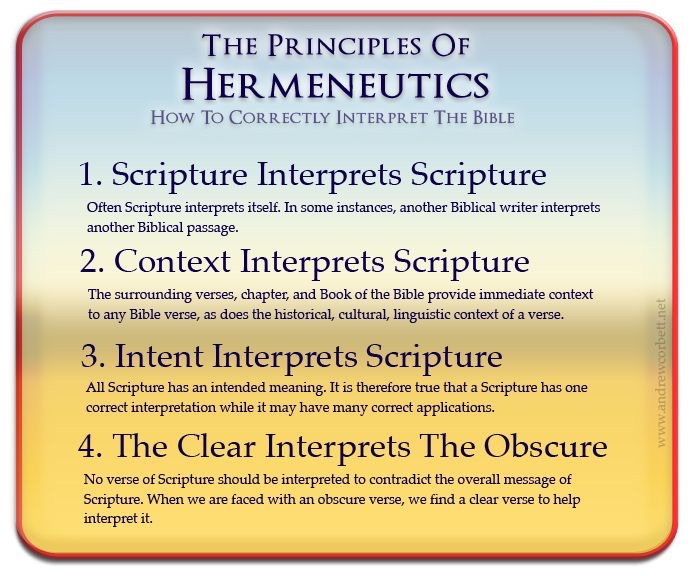
It should be obvious that many parts of the Bible require interpretation. Rather than falling for some strange, mystical, humanistic revelation and spiritualizing too much with inappropriate allegories, here are a few helpful principles of interpretation:
“Scripture interprets Scripture,”
“Consider the literary genre of each passage while knowing that context interprets Scripture,”
“Analyze the grammar and syntax while watching out for complex figures of speech,”
“The clear interprets the obscure,”
and last but not least,
“We must have a Christ-centered focus as we study each passage.”
Ultimately, we’re searching for the intended meaning, and as we learned last week, the Holy “Spirit” helps us understand and discern the “spiritual” meaning of God’s Word, while sometimes the answer we’re looking for actually IS the “spiritual realm” of the Holy Spirit, the realm where Jesus rules and reigns as King.
The Bible is written in many different literary styles, and employs many literary devices, such as euphemisms, allusion, imagery, and foreshadowing. Understanding the proper “literary context” of each passage in the Bible is a huge step towards interpreting correctly. It might be more accurate to pursue proper “literary context” rather than extreme “literalism.”
In order to help us discern the literary context, the main divisions of Biblical genres are: narrative, law, poetry, wisdom, prophecy, gospel, letter, and history. We must perceive which genre we’re reading, and abide by the interpretive rules of that particular genre as we read different passages of Scripture. This “literary context” gives a better understanding of what the author is intending to say, which increases the chances of accurately interpreting the message.
Correctly understanding the Bible means recognizing that literal historical accounts are literal history, metaphors are metaphors, and poetry is poetry. But then there’s apocalyptic prophecies, which employ heavy usage of symbolism, yet fortunately the Bible itself often explicitly defines those symbols in other parts of Scripture. Therefore, studying all of the Bible is required to find the keys to unlock those symbols.
Furthermore, notice what the Bible tells us in 2 Timothy 3:16, “All Scripture is God-breathed and is useful for teaching, rebuking, correcting and training in righteousness.” Notice that it said “all” Scripture. All of it is useful, not just the simple, easy, obvious sections we’ve heard countless times on Sunday mornings, but also the more difficult and challenging sections which we mustn’t ignore.
A few passages to consider which highlight the deeper meanings to search for:
“It is the glory of God to conceal a thing: but the honor of kings is to search out a matter,” (Proverbs 25:2).
The following is Adam Clarke’s commentary on that passage:
“This has been understood as referring to the revelation of God’s will in His Word, where there are many things concealed in parables, allegories, metaphors, similitudes, etc. And it is becoming the majesty of God so to publish His will, that it must be seriously studied to be understood, in order that the truth may be more prized when it is discovered. And if it be God’s glory thus partially to conceal his purposes, it is the glory of a king to search and examine this word… Prophecies are partially concealed; and we cannot fully know their meaning till their accomplishment; and then the glory of God’s wisdom and providence will be more particularly evident, WHEN WE SEE THE EVENT correspond so particularly and exactly with the prediction.”
As was just hinted at, and as has been documented by countless theologians over many centuries, most predictions which our generation commonly assumes are still future have actually already been fulfilled throughout Church history, and rather than remain blind, it’s quite eye-opening and empowering to learn how God has been fighting for His Church and fulfilling His prophecies one by one during these last 2,000 years.
Here are two more passages about looking for a deeper meaning:
“I will open my mouth in a parable: I will utter dark sayings of old,” (Psalms 78:2). [Scripture calls them “dark,” not to imply anything sinister or evil, but rather because the meanings are hidden/concealed/obscured. They’re meant to be figured out through careful, prayerful contemplation as the Holy Spirit helps reveal the true meaning.]
In the same way, we read this in Proverbs 1:5-6:
“A wise man will hear, and will increase learning; and a man of understanding will attain unto wise councils: to understand a proverb, and the interpretation; the words of the wise, and their dark sayings.”
As implied in that passage, these hidden / “dark” sayings must be “interpreted,” therefore there’s a deeper meaning than what’s revealed by the original “literal” words.
In continuing to mature, instead of being content to be passively fed by a “professional” preacher only once per week, here’s something the Bible says we should be doing:
“STUDY to show yourself approved unto God, a workman who need not be ashamed, rightly handling the word of truth,” (2 Timothy 2:15).
Rather than just casually reading the Bible, we’re encouraged to evaluate and ask tough questions, to truly “study” the Bible and to learn to handle its contents correctly. Furthermore, we’re taught in Hebrews 5 that there’s a skill we should pursue in learning how to properly study and interpret Scripture,
“For though by this time YOU OUGHT TO BE TEACHERS, you need someone to teach you again the basic principles of the oracles of God. You need milk, not solid food, for everyone who lives on milk is unskilled in the word of righteousness, since he is a child. But solid food is for the mature, for those who have THEIR POWERS OF DISCERNMENT TRAINED by CONSTANT PRACTICE,” (Hebrews 5:12-14).
That wasn’t suggesting that we need only milk, but instead was a criticism of those who hadn’t grown up after spending too much time in only receiving the basics. We see in the very next verse which has the title of “The Peril of not Progressing” –
“Therefore, leaving the discussion of the elementary principles of Christ, let us go on to perfection, not laying again the foundation…” (Hebrews 6:1).
In those passages, although it’s good and necessary for beginners to learn the simple Gospel, those who have been in the “Church” for decades should now be ready to move on past the “basic, elementary principles,” and to have our “power of discernment trained by constant practice.” Did that passage say that maybe, someday, we might try to look for an opportunity to train our power of discernment. No, it said we must constantly practice training our power of discernment. And to do that would mean actually exposing ourselves to challenging topics like we’re currently doing here, rather than remain being satisfied with simply consuming the elementary principles of our faith. We must learn to grow up and feast on that wonderful “solid food” instead of only passively consuming baby’s milk. And when we do, we’ll fortunately discover that there truly are so many amazing and empowering things we can learn when we dig deeper into Scripture.
1 Corinthians 2:6-7 has the title of “Spiritual Wisdom,” and states, “we speak wisdom among those who are MATURE, yet not the wisdom of this age… we speak the wisdom of God in a mystery, the hidden wisdom which God ordained.”
When “mature” believers begin to study for themselves, not only might they be surprised to realize that part of the “mystery” and “hidden wisdom” are actually “spiritual” fulfillments that’ve already occurred, they should also begin to discern the importance of symbolism and hyperbole in frequently misunderstood prophetic passages. Regarding the challenge of deciding whether a prophetic passage is exceedingly “literal,” or if the actual fulfillment demonstrates that hyperbole had been used (hyperbole is a figure of speech in which exaggeration is used for emphasis or effect), here are some examples of the Biblical usage of hyperbole:
“When the author of 2 Kings wants to emphasize the piety of King Hezekiah, he says, ‘There was no one like him among all the kings of Judah, either before him or after him’ (2 Kings 18:5). When later he describes Josiah in a similar way, ‘Neither before nor after Josiah was there a king like him who turned to the Lord as he did….’ (2 Kings 23:25). Both verses employ hyperbole to emphasize the unusual devotion these two kings had for God [it would be virtually impossible for those same statements to have been true of each individual king unless hyperbole was being used]. Some have taken literally the hyperbolic statements of Jesus about gouging out an eye or cutting off a hand (Matt. 5:29-30) or about self-castration (Matt. 19:12), with tragic results. Jesus is using hyperbole to emphasize the importance of resisting sin rather than blaming our transgression on our ability to see and touch or on our power to reproduce,” (original source here).
Our upcoming studies will delve deeper into prophetic passages and explore whether symbolism was used, or if literalism should be employed. As mentioned earlier, there’s a relatively new, yet currently popular theological system, known as dispensationalism, that claims to take the most “literal” interpretation of Scripture. However, when examining that system, it becomes apparent that it doesn’t even consistently apply its literalism, and instead ignores what’s literally taught in some texts in order to push its unorthodox narrative and harmful worldview.
We’ll now briefly look at a few important topics that we’ll eventually study in-depth:
1. Christ-centered Israel
Is Israel a piece of land in the Middle East? Or is Israel a group of people who have a certain type of DNA? Or is it something completely different? Do Christians have any connection at all, in any way, to the name “Israel?” The main characteristic of that unfortunately popular yet relatively new, unorthodox theology is the complete and total separation of the Church and Israel. But is that what Scripture teaches? And who are “the children of the promise?”
2. Christ-centered Law
How are we to know and follow God’s Law? Is the Law given to Moses our ultimate authority, or has that Law “passed away?” Is that Law now “obsolete” and replaced by a higher standard known as “the Law of Christ” that’s “more glorious” and is “not like” the Old Covenant Law given to Moses?
3. Christ-centered Kingdom
Did Jesus already inaugurate His Kingdom, or was He forced to delay it when the Old Covenant nation of Israel rejected Him? Is His Kingdom something that will someday be physically seen by unbelievers? (Keep in mind that in John 18:36 Jesus told us that His Kingdom isn’t of this world, and in Luke 17:20-21 Jesus said that the Kingdom isn’t something that can be physically seen). Is Jesus already the King, or can He only become King in a future earthly millennial reign?
4. Christ-centered Worldview
Should Christians have a pessimistic worldview expecting gloom and doom for our planet, unwilling to pray for persecuted believers because these things are supposedly just part of God’s will for us, and we should expect that everything is supposed to be getting worse while we wait for it to finally get so bad that we can then be raptured away so that the real “tribulation” can begin? Or, does Daniel 2:31-45 teach that the Kingdom started out small like a mustard seed that’s slowly growing into a mountain that crushes all other kingdoms? Those are radically different worldviews, but which one is correct?
5. Christ-centered Temple
The Old Testament had prophesied that the Messiah would be the one who would build the final Temple. Then the New Testament explains in 5 different passages that the Body of Christ (which is known as the Church) is the Temple, and its individual members are described as the “living stones” of that spiritual building. Scripture doesn’t use a metaphor to say that we are merely “like” a temple, but rather, it says we are “the” Temple. And it says that Jesus is the “chief cornerstone” of that building. Has this really been fulfilled, or does it still await a future fulfillment? Many say it’s already been fulfilled, but that relatively new theological system says no, because it thinks there must be a literal, physical, earthly Temple building. Which is it? And to which Temple is 2 Thessalonians 2:4 referring? In other words, is a single antichrist going to sit in a future, rebuilt, literal physical Temple? Should we be fearful of an evil, super-powerful, global tyrant boogeyman, or should we be empowered knowing that 2 Thessalonians 2 has already been fulfilled and won’t happen again? Even though they absolutely were not Preterists (thinking it might’ve happened before 70 AD), were our ancestors correct when they documented that it had already occurred centuries after 70 AD? Is the simple truth much less sensational and less fascinating than what’s been dreamed up by our generation’s bestselling “Left Behind” books and movies? When someone asks the question, “What does the Bible say,” they’ll be surprised at the specific and undeniable details in the Bible which answer those questions.
6. Christ-centered Daniel 9
Did that relatively new theological system invent something they call “7 years” of “the” great tribulation in order to separate the Church from Israel, so that God might focus His attention back to His “chosen people,” a group of people who are supposedly chosen simply by the composition of their DNA. Or, is all of that based upon a false, futuristic reading of Daniel 9, which was relatively unknown prior to that new system? (The previous and virtually unanimous interpretation of Daniel 9 had always been focused on Jesus, His New Covenant, and all that He had already fulfilled).
7. Christ-centered End
A great deal of time has been spent by believers arguing whether there will be a pre-tribulation, mid-tribulation, or post-tribulation “secret” rapture, when Jesus would supposedly be coming back two more times, but has all of that just been an unnecessary, unfruitful, complete waste of time, based upon a false, futuristic interpretation of Daniel 9, and a misunderstanding of the already fulfilled 1,260 days? Keeping in mind again that they were not Preterists, did our ancestors already accurately point out the true meaning and fulfillment of the 1,260 days?
We’re going to learn next week that the Bible does NOT teach “7 years” of worldwide great tribulation! That’s only a false, relatively new doctrine based upon a futuristic interpretation of Daniel 9. However, this study is NOT primarily an end times study, nor will it attempt to say that everything was fulfilled in 70 AD (such as the Preterist view). Rather than futilely trying to anticipate the future, we’ll instead almost exclusively be looking back to see how valuable and empowering it is to examine what Jesus might’ve already fulfilled, and we’ll begin by studying the Traditional Interpretation of Daniel 9. It’s time to put our focus back on Jesus Christ.
 “Helping People See Jesus and Exploring All That He Has Fulfilled”
1 thought on “Do We Appreciate Everything Jesus has Fulfilled?”