2nd Semester / Week 1
(To listen to this study on YouTube, click here)
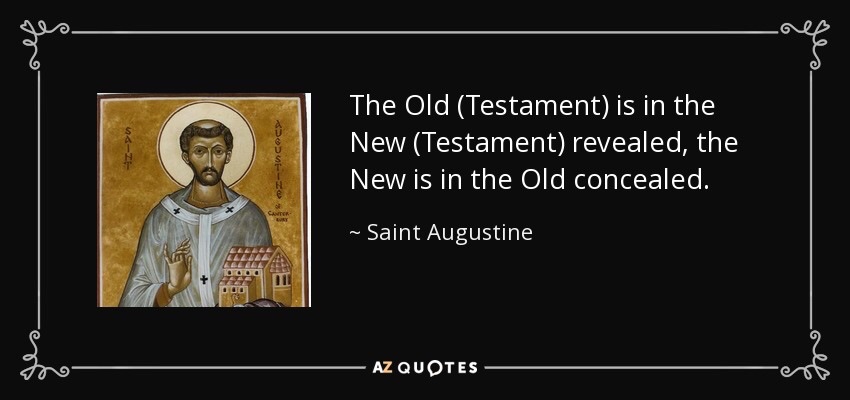
The early Church theologian Augustine (354 to 430 AD) wrote regarding the Old and New Testaments: “The New is in the Old concealed; the Old is in the New revealed.” Essentially, the New Testament explains what the Old Testament was really trying to say, and this shows us that the early Church realized that without the teachings of Jesus and His apostles we can’t grasp the true intention of the Old Testament.
“The currently popular ‘historical-grammatical method’ of studying Scripture can certainly be helpful, however, theologians have realized that the New Testament teaches us how to read the Old Testament in a Christological (Christ-centered) and salvific manner that extends beyond a literal historical-grammatical reading of the Old Testament. The tail (Old Testament) does not wag the dog (New Testament); the Old is not the interpretive control of the New; rather, the revelation of the Christ event given in the New Testament is the interpretive control for the whole canon of Scripture,” (J. Angus Harley, author of A New Covenant Theology Critique of the Adamic Covenant, as well as Galatians and the New Covenant Theology Hermeneutic).
This is one estimate of the many Old Testament references found in the New Testament:
•Quotes: 302
•Allusions: 493
•Possible allusions: 138
•Total: 933
Since it was mentioned so many times, then when studying what was written by the Holy Spirit inspired New Testament authors, how did they interpret the Old Testament? Did they always give a logical, literal interpretation, or was a deeper, spiritual interpretation often given?
This is a very important aspect of Scripture we’re evaluating. For instance, when we finally find the proper understanding of “the Israel of God,” we can then look back into Old Testament passages, such as when Hebrews 8 looks back and quotes Jeremiah 31:31-33:
“Behold, the days are coming, says the Lord, when I will make a NEW COVENANT with the house of ISRAEL… not according to the covenant that I made with their fathers in the day that I took them by the hand to lead them out of the land of Egypt… this is the covenant that I will make with the house of Israel after those days, says the Lord: I will put My law in their minds, and write it on their HEARTS; and I will be their God, and they shall be My people,” (Hebrews 8:8-10)
A similar theme regarding God’s work on our hearts is found in Ezekiel:
“I will give you a new HEART and put a new SPIRIT IN YOU; I will remove from you your heart of stone and give you a heart of flesh,” (Ezekiel 36:26).
Rather than only literal, physical and fleshly circumcision, this change of heart is the true intended circumcision, which can also be seen in Old Testament passages such as Deuteronomy 10:16 and 30:6. That’s what the fleshly circumcision had foreshadowed, as is taught in New Testament passages such as Colossians 2:11, Romans 2:25-29 and Acts 7:51.
Hopefully everyone in our group (or whoever is reading this) personally knows what this is talking about, and the complete change that occurs when the Holy Spirit dwells in you, and you begin to be directly led by the Holy Spirit. If not, then pray and confess that Jesus is not merely your savior, but that He is also your Lord/King/Ruler. It would also be good to pray every day to be filled full of the Holy Spirit (see Luke 11:11-13) in order to be convicted of sin, given power to conquer sin and to bear the fruit of the Holy Spirit who now permanently dwells in God’s redeemed people.
To recap so far, notice that the literal, physical and fleshly isn’t always the intended fulfillment, which can sometimes only be truly fulfilled spiritually, such as the true “circumcision,” which is the spiritual change that God makes on our hearts with His Holy Spirit, rather than merely a physical change on our flesh.
Let’s continue to look into how we interpret Old Testament prophecies in light of their New Testament fulfillment. Was everything going to be fulfilled literally? In Malachi 4:5, Elijah was predicted to come first before the Messiah, and yet Jesus explains that, if we will accept it, John the Baptist was the prophesied Elijah. This is found in the Gospel of Matthew:
“Jesus began to say to the multitudes concerning John: “What did you go out into the wilderness to see?… A prophet? Yes, I say to you, and more than a prophet. For this is he of whom it is written: ‘Behold, I send My messenger before Your face, Who will prepare Your way before You.’ Assuredly, I say to you, …if you are willing to receive it, HE IS THE ELIJAH who was to come. He who has ears to hear, let him hear!” (Matthew 11:7-11, 14-15).
In that passage, Jesus quoted Malachi 3:1 and told us it referred to John the Baptist, yet he wasn’t literally Elijah because of this found in the Gospel of John:
“this is the testimony of John [the Baptist], when the Jews sent priests and Levites from Jerusalem to ask him, “Who are you?” He confessed, and did not deny, “I am not the Christ.” And they asked him, “What then? ARE YOU ELIJAH?” He said, “I AM NOT,” (John 1:19-21).
Clearly, we can’t always expect obvious literal fulfillments because some things are instead symbolically fulfilled, and this is why the words of Jesus are true when He said that John the Baptist was Elijah. John wasn’t literally Elijah, but instead was symbolically Elijah, and this symbolic representation clearly fulfilled the prophecy found in Malachi 4:5. To restate, Scripture shows that a prophecy can be fulfilled by a symbolic representation, rather than an obvious, logical, literal fulfillment. The Old Testament is full of types and shadows, but the reality and fulfillments are found in the New Testament.
Interestingly, when studying Revelation, rather than pursuing extreme literalism such as is found in the popular yet wild and crazy “Left Behind” books and movies, it should instead be blatantly obvious that symbolism is found in those prophecies. In coming full circle, not only are we seeing that the New Testament interprets the Old, but when we get to Revelation, we use definitions found in the Old to help interpret prophecies in the New. Therefore, rather than using our imaginations to define those symbols, we’re to instead simply “use Scripture to interpret Scripture,” and fortunately the definitions of those symbols are directly found in the Old Testament. All we have to do is plug those definitions into the symbols and we’ll find a clear and consistent message from God, the same message that was blatantly obvious to our ancestors.
To further study symbolic representations, let’s look at Ezekiel 34:23-24 and 37:24-27 which mentions David on the throne. This too was a type or “shadow” (Colossians 2:17), but Jesus is the actual fulfillment and He is on the throne. Did it absolutely have to be a literal, physical, earthly throne where it would literally be David who sat on the throne? Consider when Jesus declared:
“The scribes and the Pharisees sit in Moses’ seat,” (Matthew 23:1-2).
Did the scribes and Pharisees sit in a literal chair Moses had sat on hundreds of years earlier? Of course not. They simply occupied the same role which Moses had occupied as leader and teacher of Israel. Likewise, the throne of David simply refers to rule given by God, a role that David had exercised in Old Testament Israel, which is now fulfilled by King Jesus as He rules from His heavenly throne over His earthly spiritual Kingdom.
What can we learn from a people group that only believes the Old Testament? Are we able to properly understand the Old Testament by turning to Orthodox Jews? Are they able to accurately study Scripture and teach us what we need to learn about the Old Testament? We find this answer in 2 Corinthians:
“But their minds were blinded, [hardened and made dull], for to this day the same veil remains when the old covenant is read. It has not been removed, because only in Christ is it taken away. Even to this day when Moses is read, a veil covers their hearts,” (2 Corinthians 3:14-15).
This is why we must help people see Jesus!!! We will only be able to properly understand the Old Testament through the knowledge of Jesus. Jesus is the lens that allows us to correctly view and understand the Old Testament.
The majority of the original people who were given the Old Testament (especially the religious leaders) completely missed to whom the entire Old Testament had pointed. Instead of recognizing their Messiah, the religious experts had basically said, “when God does something, it’ll be obvious, therefore, when the Messiah comes, we’ll know, but it couldn’t be this Jesus because He doesn’t fit our interpretation.”
It’s for these reasons that when the New Testament explains an Old Testament passage, we must let the New Testament explanation be the ultimate, final interpretation on the subject. Again, so that we don’t misunderstand Old Testament passages, we shouldn’t interpret like the Pharisees (as well as modern day dispensationalists who share the same way of interpreting Scripture). The Pharisees stubbornly clung to what they thought Scripture taught, yet we must allow the New Testament explanation of Old Testament passages be our ultimate authority, and this is the only way that we can learn the true meaning of Old Testament passages.
As it turns out, a large part of the foundation of dispensationalism was laid by Arno Clemens Gaebelein as he worked with, and learned from, Orthodox Jews who had misunderstood Old Testament passages. If it wasn’t for Gaebelein’s and others influence, then Scofield would’ve never been able to write his reference Bible. If it wasn’t for Scofield and his reference Bible, then dispensationalism would’ve never been able to nearly take over American Christianity. So now the question becomes, do we follow a theology and the denominations that had turned to Orthodox Jews to teach them how to understand the Old Testament, or do we turn to Jesus and the authors of the New Testament, and learn to spiritually discern God’s Word by the power of the Holy Spirit as we study the New Testament’s interpretation of Old Testament passages? We must remember that the literal, physical and fleshly isn’t always the intended fulfillment, because sometimes it’s only truly fulfilled spiritually. Hopefully we will see JESUS more clearly as we learn how to understand Scripture.
 “Helping People See Jesus and Exploring All That He Has Fulfilled”
1 thought on “How are We to Understand the Old Testament now that the New Testament has Shed a New Light on it?”