
3rd Semester / Week 2
(The following selections are from pages 493-495 of Kingdom Through Covenant by Peter Gentry and Stephen Wellum of The Southern Baptist Theological Seminary, and is available here. These excerpts help establish the foundation for understanding Isaiah’s “Servant” and how His identity relates to Israel and Jesus.)

“The First Servant Song [in Isaiah]… is devoted to the theme of the consolation of Israel and of the nations (Isaiah 40:1-42:17). The Abrahamic covenant undergirds this introductory section. At the heart of the covenant with Abraham is the promise that blessing will come to the entire world through Abraham and his family, Israel.”
“The arrangement in this section is important. The consolation of Israel comes first because at this time Israel is under a curse; she is part of the problem and not part of the solution. First, God must console and restore Israel, and only then can He use Israel to be an instrument of consolation and restoration for all the nations… At this point, three passages on the ‘Servant’ of the Lord are placed together to focus on redemption from sin.”
“The literary structure sheds light on the identity of the ‘Servant.’ Debate over the identity of the ‘Servant’ has raged for centuries and continues to the present time unabated. One good reason for this debate is in the text itself: it is characteristic of Isaiah’s style to begin discussing a topic in an ambiguous and mysterious manner and to add critical information bit by bit until the matter is plain. For example, in the oracle against Babylon in 21:1-9, Isaiah begins by talking about the wilderness by the sea. Only at the end, in 21:9, does one realize that the prophet is speaking about Babylon. Isaiah’s presentation of the servant of Yahweh is similar. At the start, in 41:8, the servant is Israel, who in the biblical-theological scheme of the larger story has inherited the Adamic roles of son of God and servant-king, and who in the covenant at Sinai in Exodus 19:5-6 was called to be a holy nation and a kingdom of priests. The servant, however, seems to be deaf and disobedient in Isaiah 42:18-19. This contradicts the picture of the servant in 42: 1-9 and especially in 50:4-11. Israel as a servant is in dire need herself, not just of rescue from exile and all that that entails but also of a full resolution of the problem of a broken covenant relationship (e.g., 43:22-28). Idolatry and social injustice are endemic in Israel. This is the dilemma: How can God keep his promises to Abraham when Israel has completely failed as “the servant” of the Lord?”
“The answer to this question is addressed immediately in the Second Servant Song, which begins the detailed response to this question (49: 1-13). At the beginning of this Second Song, in 49:3, we hear again the affirmation that Israel is the servant, as in 41:8. Yet in 49:5-6, the servant’s task is to bring the nation back. This is a return from exile, both physically and spiritually, as described earlier. How can the servant be both the nation and the deliverer of the nation? There is only one possible solution that resolves this conundrum fairly, and Isaiah has prepared us for this in the first part of his work: the Servant must be the future king described earlier (eg., Isaiah 11: 1-10). As an individual, the king can say, “I am Israel.” The king can represent the nation as a whole, yet he can be distinguished from Israel. This is difficult for Americans to grasp because we have no monarchy. In monarchies, both ancient and modern, there is a sense in which the king is the nation. At the same time, the king is the deliverer of the nation and fights her battles for her. Many Christians move too quickly to identify Jesus of Nazareth as the servant of Yahweh without following carefully the progression in the text. The main problem with the standard Jewish interpretation of identifying the Servant as the nation is that the nation of Israel is neither in the text nor in history able to rescue itself, let alone atone for its own sins. What clinches the argument for the Servant being an individual is the fact that in Isaiah 49:6 the Servant delivers the nation and that in Isaiah 53 the detail is so rich that it could not be anyone but an individual (See Peter Gentry, ‘Atonement in Isaiah’s Fourth Servant Song’).”
(End of quotation from Kingdom Through Covenant)
——————————————-
To begin to summarize as well as apply what was just stated, the Old Testament reveals that the “Servant,” who is clearly Jesus, is the representative King of the nation of “Israel.” Note that His Kingship was even recognized by Nathanael as he boldly declared:
“Rabbi, You are the Son of God! YOU ARE THE KING OF ISRAEL!” (John 1:49).
Nathanael didn’t say that someday Jesus might become King, but rather, he said Jesus is already the King of Israel, and we should be aware that as the King, Jesus is the representative of His nation.
This representative pattern is also seen in the Christ-centered foreshadowing of David’s battle with Goliath. As was pointed out in the movie American Gospel: Christ Alone, it’s sometimes taught that we can be like David and defeat the giants in our life. However, as that movie correctly demonstrates, theologians have documented that isn’t the point of the story at all, and is even a false and misleading interpretation. The Old Testament is full of “types and shadows” which point to Christ. The account of David and Goliath is Christocentric (Christ-centered). In it, David represents Christ and is a foreshadowing of Christ defeating sin and death for us. In the story of David and Goliath, we’re the hopelessly scared “Israelites” completely unable to conquer our foe which is sin and death, and we thankfully rejoice when our representative King conquers them for us. We merely trust, follow and obey the Commands of our King as He leads and guides us with His Holy Spirit.
As it turns out, the original “Israel” was also a “type and shadow” which had pointed to the ultimate fulfillment in Jesus. It’s not merely that Israel=the Church, but rather, it’s critical to see that Jesus is the representative head of His nation, therefore Israel=Jesus=the Church. Jesus is the “telos” of Israel, and we’ve seen in Galatians 3:28 that we’re all “one” in Jesus, we’ve been connected to Jesus who is the true “branch” and true “vine,” and many other passages also teach that we’re “in Christ.” Simply put, Israel reaches its fulfillment in Christ, and those united to Him share in that identity.
All of that is an important distinction, because we’re not connected to the name “Israel” without going through King Jesus. Also, remember that Romans 9:6-8 taught there are two different Israels, and as seen in the olive tree of Romans 11, those without Jesus have been “cut off” from the true Israel and are now merely the Israel of the flesh. The significance of that distinction, that we’re not connected to the true Israel without being connected to King Jesus, is something we’ll examine next semester, because throughout Church history some incorrect presuppositions had been made by those who assumed the Church is the same as the mostly unregenerate Old Covenant nation of Israel and would therefore supposedly contain both believers and unbelievers inside the Covenant community. However, that view minimizes the true saving power of the New Covenant which provides a fully regenerate, Spirit-filled community.
Stephen Wellum, Professor of Christian Theology at The Southern Baptist Theological Seminary, put our relationship to Israel and Jesus this way: “we must think of the Israel-church relationship Christologically. The church is not directly the “new Israel” or her replacement. Rather, in Christ Jesus, the church is God’s new creation, comprised of believing Jews and Gentiles, because Jesus is the last Adam and true Israel, the faithful seed of Abraham who inherits the promises by his work (Gal. 3:16; Eph. 2:11-22). Thus, in union with Christ, the church is God’s new covenant people in continuity with the elect in all ages, but different from [national] Israel in its nature and structure. Now, in Christ, both believing ethnic Jews and Gentiles stand equally together and inherit all of God’s promises in him (Gal. 3:26-4:7). And, furthermore, the relationship between Christ and his people is inseparable. For this reason, the church receives all of God’s promises in Christ.”
As was just stated, we need to appreciate how the Church is different from the “nature and structure” of what had been the mostly unregenerate nation of Israel. Jesus is instead now King over His fully redeemed and fully regenerate (born again) spiritual Kingdom of Israel. The “more glorious” aspect of New Covenant Israel is that we’re all empowered with the living Holy Spirit who dwells inside each of us who are within His New Covenant community. The guidance we receive from the Holy Spirit is what makes the New Covenant “more glorious” than the “obsolete” Old Covenant (2 Corinthians 3).
Matthew 2:6 reveals that Jesus is the “ruler who will shepherd My people Israel,” therefore, those who belong to Him are included within “Israel” because Jesus is our “Lord” which literally means “ruler,” and we are His “people.” It’s all a perfect fit. As we’ve been learning, the New Covenant was established at the First Advent and was offered to national Israel. Then the first 3,000 Christians were all Jewish. It had a Jewish foundation. The New Covenant was made with Israel whether they liked it or not, just like how God made the Abrahamic Covenant while Abraham was asleep and whether he liked it or not. Yet Israel had never been genetically pure, instead it had always contained a “mixed multitude” who were to be “considered as native born” and married into Israel. The genealogy of Jesus is noteworthy for containing Gentiles, while Old Covenant Israel was also noteworthy for having to “cut off” those that didn’t keep the Covenant. The true modern Israel is simply exactly the same.
Many throughout the centuries have stayed in Israel and are part of New Covenant Israel by being connected to the True Israel of God, King Jesus. And just like Old Covenant Israel, many others have also been “added,” but they must maintain a Covenant relationship with God. Unfortunately, there are many who had been in national Israel who aren’t within the New Covenant and therefore have been “cut off,” just as had taken place in Old Covenant Israel. They were “cut off” because they don’t have Jesus as their New Covenant King. It’s always been the exact same process. Some have been “added” while some have been “cut off.” Same as it ever was. And now, within New Covenant Israel, as foretold in Jeremiah 31:33-34, everyone in our New Covenant Israel personally knows the Lord, we have His Law written on our hearts and we’re also guided by His “more glorious” Holy Spirit who helps keep us within His will.
Finally, let’s now look into one of the most controversial verses regarding “Israel,” Galatians 6:16, which specifically mentions “the Israel of God.” But before we do, we need to look at a passage that also talks about the “new creation” which is mentioned in the preceding verse of Galatians 6:15:
“Therefore, from now on, WE REGARD NO ONE ACCORDING TO THE FLESH… Therefore, if anyone is in Christ, he is a NEW CREATION; old things have passed away; behold, all things have become new,” (2 Corinthians 5:16-17).
Now that we’ve seen that relevant information about being a “new creation,” notice that Paul similarly closes his letter to the Galatians this way:
“For in Christ Jesus neither circumcision nor uncircumcision avails anything, but a NEW CREATION. And as many as walk according to THIS RULE, peace and mercy be upon them, and upon the ISRAEL OF GOD,” (Galatians 6:15-16).
In putting those two passages together, we see that the “rule” that we should walk according to is that we recognize that we are a “new creation” and “regard no one according to the flesh.”
Throughout Galatians, Paul had emphasized our unity in Christ and refuted our need to participate in Jewish customs such as physical circumcision which had merely been a “type and shadow” which pointed to the ultimate circumcision of our hearts by the Holy Spirit. Paul went to great lengths to tear down the dividing wall which had been between Jews and Gentiles, and instead revealed that Christians are the true “seed of Abraham” who are the “heirs” who receive “the promises.” Therefore, it would be quite shocking and out of place for the final words to the Galatians to suddenly and radically revert back to highlighting a particular group, rather than for them to “regard no one according to the flesh.” If Paul were to conclude by suddenly distinguishing between Jews and Gentiles within the church, that would undercut his consistent message throughout this epistle and also specifically undercut the “rule” that had been laid down in the preceding verse. Since doing so would contradict Paul’s entire preceding argument, therefore, it appears that Paul instead brought his letter to its logical conclusion by staying the course and continuing the direction that his letter had been heading by finally revealing that “in Christ Jesus neither circumcision nor uncircumcision avails anything” but instead, those who have become a “new creation” are now the true “Israel of God.”
If Paul had instead closed his letter by only addressing the Israel of the flesh, then it would open up a reason for Gentiles to become circumcised in order to become a Jewish proselyte who kept all of their practices. We know that can’t be the case because in Philippians 3:3 Paul revealed that believers are the true circumcision, therefore, logically, since we’ve been told that we’re the true circumcision and the true descendants of Abraham who receive the promises in Christ, and since Christ is the true Israel and is our representative King, then we are part of His “Israel of God.” The most natural reading is that “the Israel of God” is the same group that follows the rule of the new creation: believers in Christ.
As we’ve just seen, the most decisive factor seems to be the context of the entire epistle in which that phrase “Israel of God” was found, and Thomas Schreiner, Associate Dean at the Southern Baptist Theological Seminary and Professor of New Testament Interpretation, wisely and correctly pointed out regarding Galatians 6:16, “It is unlikely that the dispute can be resolved on the basis of grammar alone.” But to briefly look into the grammer that had been used, we see that the Greek conjunction used prior to the phrase “the Israel of God,” could’ve been an appositional use of the word “καί” (appositional refers to two elements which are placed side by side so that one element identifies the other in a different way). This is not only possible, but is actually the most likely option because whichever option contributes the least new information to the total context is linguistically preferred. In other words, “To say that Paul intends the phrase to mean all believers, Jew and Gentile, is consistent with the letter and adds the least new information to the context. Therefore, an appositional usage of kai in 6:16 seems quite defensible,” (C. W. Cowan, “Context is Everything: ‘The Israel of God’ in Galatians 6:16”; SBJT 14, no. 3 (2010).
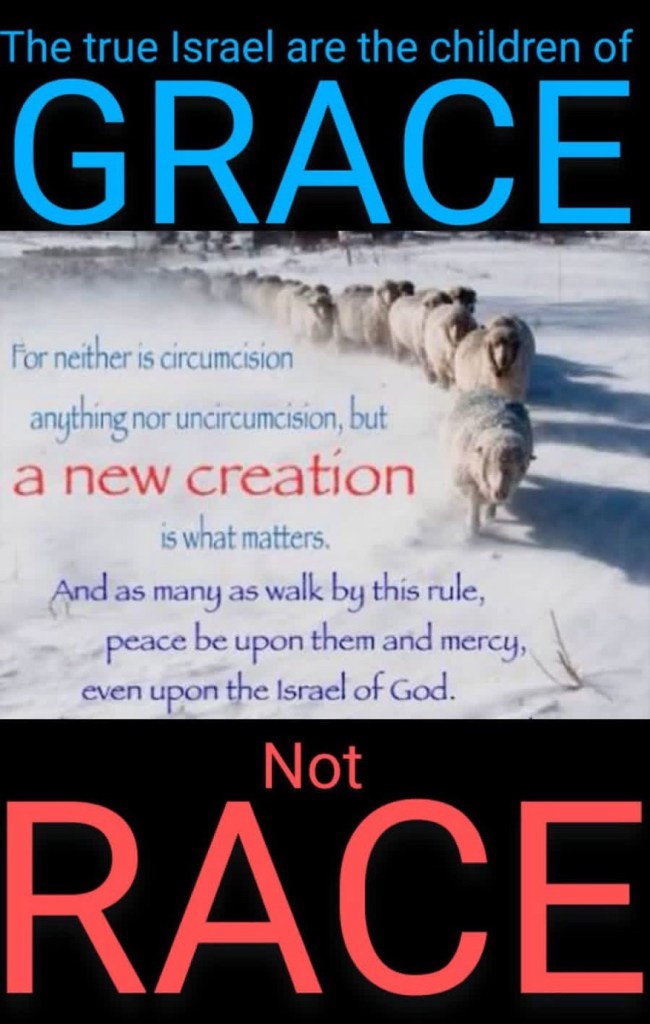
To conclude looking at “the Israel of God” in Galatians 6:16, here’s a quote from Ligonier Ministries, “With the transformation of the Law comes the transformation of the believing community. Those who walk by ‘this rule,’ those who walk by the truth of the new creation, receive the peace and mercy of the Lord (v. 16). This peace and mercy is also for ‘the Israel of God,’ which in the original Greek refers to the same group that walks by the rule of the new creation. Calvin explains that Israel here refers to all Christians, whether Jew or Gentile. Paul ‘gives the appellation of the Israel of God to those who he formerly denominated the children of Abraham by faith, (Gal. 3:29) and thus includes all believers, whether Jews or Gentiles.’ The Church, made up of Jew and Gentile, will inherit all the promises made to Israel, for the Church fulfills God’s purpose for Israel.”
Finally, in our ultimate conclusion to the question of “Who is Israel,” we can now boldly and confidently say that Scripture makes it abundantly clear that Jesus is “Israel.” He is the prophesied “Servant” of the Lord, and that “Servant” is directly called “Israel,” (see Isaiah 41:8, 49:3, as well as Matthew 2:15 which fulfilled Hosea 11:1). As the King of Israel, Jesus is the representative of His people, and we’ve been made “one” in Him in order to receive the promises that were all exclusively destined only for Him, yet, by extension, also given to all of us who are “in Christ” (Galatians 3:16, 28-29). We learned in our previous study that centuries worth of commentaries on Isaiah 44:5 have taught us that we should find it to be an honor to apply the name of “Israel” to ourselves because Jesus is the “telos” of the name “Israel,” therefore, if we’re “in Christ” then we’re automatically “in Israel.” We’ve likewise been called the “Israel of God,” per Galatians 6:16, and according to 1 Peter 2:9-10, we as Christians are now a “nation” and are THE “chosen” people of God. Furthermore, in carrying out one of the primary functions of a King, Jesus has not only led His army to battle, but has actually already fought and won the ultimate battle for His nation, just like the foreshadowing we were given when David fought Goliath as the anointed representative King of the nation of Israel. Jesus represents His people and is the King of His people, the King of the “Israel of God,” the worldwide spiritual nation under the King that now reigns over His Kingdom. And as Matthew 28:18 and Hebrews 2:7-8 affirm, “ALL” authority in Heaven and on earth has already been given to Jesus, because He is our representative, victorious King of Israel!!!
 “Helping People See Jesus and Exploring All That He Has Fulfilled”