4th Semester / Week 5
We’ve seen that what was given to Moses has been made “obsolete” and has been replaced by something greater, but what about the 10 Commandments? When many believers are asked what they should do to be holy, it’s not uncommon for them to say that we must keep the 10 commandments. Surely obeying the 10 Commandments is the ultimate definition of a Christian, right? Surely those haven’t been replaced too? This might appear to be a shocking question, but let’s continue to allow Scripture to speak for itself. Let’s study to see what the Bible tells us about what God Himself had written on tablets of stone.
As we’ve seen with a pendulum that swings too far in one direction, we should note that there are hyper-dispensationalists who believe that only the words written by Paul are for Christians and everything else is for people who have Jewish DNA. Likewise, on the other end of the spectrum, an example of someone who holds to hyper-Covenant Theology would be Theonomists/Reconstructionists who believe that the 10 Commandments should not only be enforced on each nation, but for the penalties to be enforced as well. A prime example is the Sabbath (which is Saturday) and if we’re being honest we’ll see that not only has the Sabbath day never been changed to Sunday, but the penalty for breaking the Sabbath is death (Numbers 15:35). Consequently there are a few Theonomists/Reconstructionists who actually look forward to nations implementing the death penalty for Sabbath breaking. Yet if that’s not God’s intended purpose, then wrongly putting someone to death would be murder, just like how we’ve learned about the Anabaptists who were murdered by the founders of Covenant Theology. This is a very serious issue and highlights why it’s critical to properly interpret God’s Word and to know the proper Biblical balance.
We’re about to study one of the most convincing passages declaring that not only has the New Covenant already begun for Christians, but the Old has passed away. We must be able to appreciate the “newness” of the New Covenant and see that God now leads and guides His people in an entirely new, different and better way. According to this chapter in 2 Corinthians, the prophesied ministry of the Holy Spirit is “more glorious” than the Old Testament Law that was “written and engraved on stones” (ie, the 10 Commandments). Here are these powerfully convincing words:
“our sufficiency is from God, who also made us sufficient as ministers of the New Covenant, NOT OF THE LETTER BUT OF THE SPIRIT; for the letter kills, but the Spirit gives life. But if the MINISTRY OF DEATH, WRITTEN AND ENGRAVED ON STONES, WAS glorious… how will the ministry of the Spirit not be MORE glorious? For if the MINISTRY OF CONDEMNATION HAD glory, the ministry of righteousness exceeds much more in glory… For if WHAT IS PASSING AWAY WAS glorious, what remains is much more glorious… But even to this day, when Moses is read, a veil lies on their heart. Nevertheless when one turns to the Lord, the veil is taken away. Now the Lord is the Spirit; and where the Spirit of the Lord is, there is LIBERTY,” (2 Corinthians 3:6-17).
By simply allowing Scripture to speak for itself, we learn from that passage that the Law was the ministry of “death” and “condemnation” (so that no man apart from Christ could be justified), but what was written on stone (the 10 Commandments) has “passed away” and was replaced by something better (the ministry of our indwelling Holy Spirit).
The Old Covenant was powerless to save, but the New Covenant is a powerful saving Covenant. We should remember that the Mosaic Old Covenant Law was given to a mostly unregenerate, hard-hearted nation, but is too low a standard for a believer who is filled with the Holy Spirit. Galatians 5:18 declares: “if you are led by the Spirit, you are not under the Law.” On our own, we will never be able to conquer sin. There’s nothing we can do to clean ourselves up to make ourselves presentable to our Father in Heaven. We’re completely and utterly dependent on God to do the necessary work. But the Good News is that this is precisely the glory found in the New Covenant. This New Covenant is our new agreement, our new contract with God, which contains the empowerment we need to have a redeemed relationship with God. Not only has the work been done by Christ to cover our sins, but the New Covenant also contains the empowerment of our indwelling Holy Spirit which continues to work in us to change us from within and to lead and guide us to do the Father’s will, as He molds us into His image.
The New Testament tells us that we shouldn’t attempt to put new wine back into old wine skins (Matthew 9:17), which means that we aren’t supposed to try to put Christianity back into the Mosaic Old Covenant Judaism. But before someone can learn how to live a Christian life, they need to appreciate the new standing we have with God through His New Covenant, and only through this knowledge will our behavior be able to match our righteous standing we’re given. For example, “Let us consider the overall structure of Paul’s letters. It is Paul’s practice to lay out the doctrinal foundations before turning to “ethics”… Ephesians… can be nicely divided into two sections: chapters 1-3 and chapters 4-6. Chapters 1-3 lay out the spiritual blessings in Christ for the individual and the community. After laying out a lot of doctrine, Paul urges them “to live a life worthy of the calling” they have received (4:1). The first half is about the creation of the new humanity, and the second half is about the conduct of the new humanity… This sort of “gospel logic” is found throughout Paul’s writings,” (New Covenant Ethics by Blake White, pg. 43-44).
This is the route we’ve undergone through our study. In the beginning we learned how to read the Bible and the empowerment of our standing with God. Because of what Jesus has done for us as our representative high priest, we’re all empowered priests of the New Covenant and all together we’re the Israel of God, the people of the King of Israel, King Jesus. Properly understanding this knowledge will empower us to know how to live a life for our Savior and Creator by submitting to His Holy Spirit that permanently indwells inside us when we’re regenerated (born again with the Spirit).
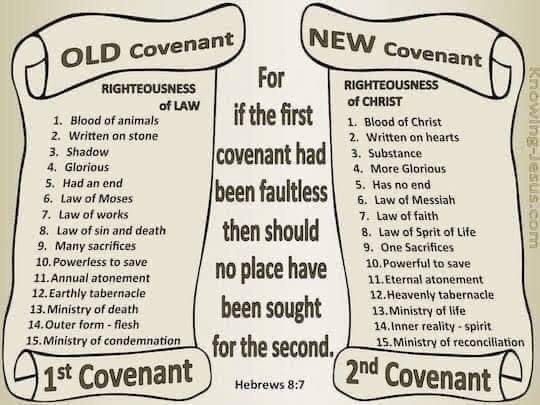
Just because the 10 Commandments have passed away, there isn’t lawlessness, because something better has replaced it. The Decalogue [10 Commandments] given to national Israel was mostly “thou shall not..” and was for a mostly unregenerate people, but New Covenant life in the Spirit is to be led by the Spirit, and to naturally have good works flow from us because (and only because) we’re connected to the vine, the root, the true Israel of God, Jesus. The Old Covenant was based on fear, while the New is based on love, and love is a much more powerful motivator than fear.
Our key passage, 2 Corinthians 3, has taught us that the 10 Commandments have passed away and have been replaced by something better, but before someone gets the wrong idea from this study, it’s important to point out that 9 of the 10 Commandments were reaffirmed in the New Testament. All except the Sabbath day were reaffirmed, and a Christian doesn’t have the liberty to freely break one of those other 9 Commandments, because not only do they fall under the category of “My Commandments” given by Jesus, but more importantly, our indwelling Holy Spirit would be screaming out inside of us and wouldn’t give us peace if we broke one of those Commandments. For example, a true believer filled with the Holy Spirit doesn’t need a written Law telling them they shouldn’t murder. It’s not only redundant, but is below us, because we have something greater that guides us into the higher standard of a much holier life.
Let’s now briefly look at what the New Testament tells us about the Sabbath. Again, it never tells us that the Sabbath day was ever moved from Saturday to Sunday. Believing the day was changed was simply a theological guess to assume it was changed to Sunday. Instead, we traditionally gather together on the same day that Jesus rose from the grave, therefore we meet on the first day of the week (Sunday) rather than the last day of the week (Saturday).
Rather than imploring us to meticulously keep the Sabbath, here’s what the Bible actually says:
“One person esteems one day above another; another esteems every day alike. Let each be fully convinced in his own mind. He who observes the day, observes it to the Lord; and he who does not observe the day, to the Lord he does not observe it,” (Romans 14:5-6).
That’s hardly a declaration telling us to keep the Sabbath, but rather, it simply says that we can think “every day” has the potential to be a day to honor and serve God, and we’re allowed to “be fully convinced” to “not observe the day.” But just to make sure we haven’t misunderstood what precise day was being discussed, here’s this from Colossians:
“So let no one judge you in food or in drink, or regarding a festival or a new moon or sabbaths, which are a shadow of things to come, but the substance is of Christ,” (Colossians 2:16-17).
There it is, in black and white, where the word Sabbath was specifically stated, and we’re told to not let anyone judge us us regarding the Sabbath, because it was merely a shadow that found its ultimate fulfillment in Jesus. So now, what does it mean to find the fulfillment of the Sabbath in Jesus?
Hebrews 4 is the definitive passage regarding Jesus as our Sabbath rest which we’re invited to now enter into. After three chapters teaching how Jesus is superior to angels and He is now our Apostle and High Priest, this chapter pleads with the Hebrews to not to harden their hearts as their fathers had in the wilderness. Unbelief had denied that generation’s access to the holy land, and God had said:
“They shall not enter into My rest” (Hebrews 3:11).
In the same way, chapter 4 implores us to not make the same mistake in rejecting God’s Sabbath rest that were to find in Jesus Christ:
“There remains, then, a Sabbath-rest for the people of God; for anyone who enters God’s rest also rests from his own work, just as God did from his. Let us, therefore, make every effort to enter that rest, so that no one will fall by following their example of disobedience” (Hebrews 4:9–11).
But notice what timeframe the preceding passage specifically tells us? It says, the day to enter that Sabbath rest is… “Today.”
“…He designates a certain day, saying in David, “Today,” (Hebrews 4:7).
“Today” is the day for someone to find their Sabbath rest in Jesus rather than trying (and failing) to do the works for salvation on their own.
And now, for the ultimate use of the word “rest” … what does Jesus Himself tell us?
“Come to me, all you who are weary and heavy burdened, and I will give you REST. Take my yoke upon you and learn from me, for I am gentle and humble in heart, and you will find REST for your souls. For my yoke is easy and my burden is light,” (Matthew 11:28-30).
That’s what Jesus gives to His people in this current life. Praise God for the rest we can now find in Jesus from us having to try (and fail) to do works to save ourselves. Good works now simply flow from us because we have the Holy Spirit leading and guiding and empowering us. Knowing that there’s frequently a “now / but not yet” aspect to many aspects of our faith, there’s still a final and ultimate rest in our future, however, again, according to Hebrews 4:7, the day to enter our Sabbath rest in Jesus is “Today.”
To conclude, we always need to appreciate the Biblical tension between continuity and discontinuity of the terms stated in the Mosaic Old Covenant. Our key passage, 2 Corinthians 3, has taught us that the 10 Commandments have passed away and have been replaced by something better. It specifically said that what was “engraved on stones” had been glorious but was “passing away” has been replaced by something “more glorious.”
All of this this brings us to the next topic that we’ll study in the next lesson on Hebrews 12:
How does God teach His children how to do what’s right? (A hint is that it’s the same way that most parents teach their children)
 “Helping People See Jesus and Exploring All That He Has Fulfilled”