5th Semester / Week 5
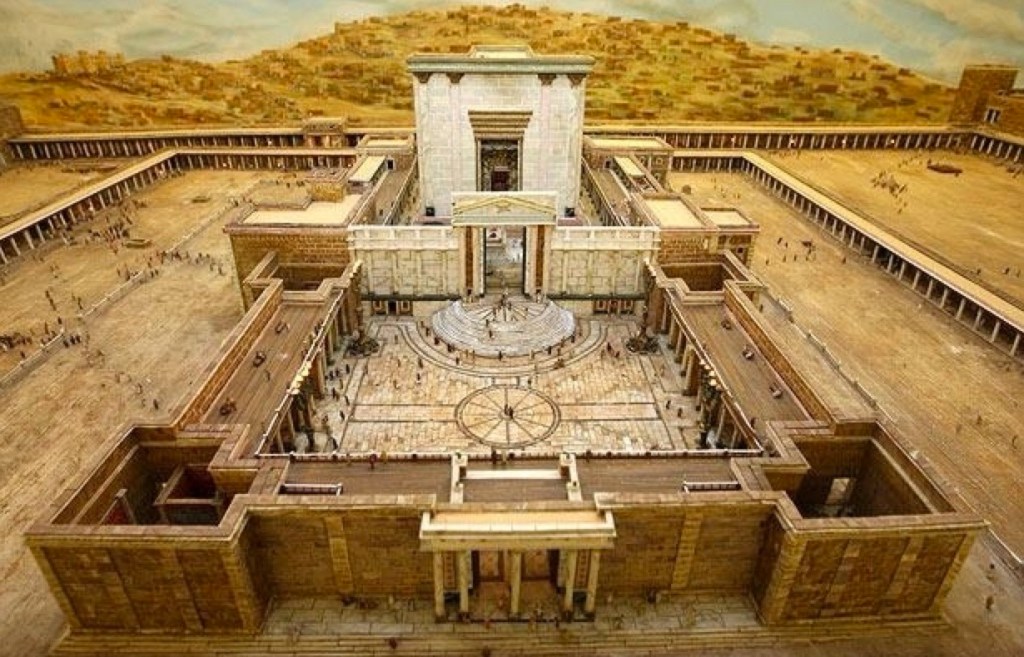
In the previous study we saw the problem that dispensationalists have in not keeping to their “literal” interpretation when Ezekiel 45 literally mentions that the Temple sacrifices would be for the “atonement” of sin. That’s a huge problem since Hebrews teaches that the ultimate and final sacrifice was made by Jesus:
“…when Christ came into the world, he said… ‘You have neither desired nor taken pleasure in sacrifices and… SIN OFFERINGS… Behold, I have come to do your will.’ He does away with the first in order to establish the second [He took away sacrifices in order to do God’s will]. And by that will we have been sanctified through THE OFFERING OF THE BODY OF JESUS CHRIST ONCE FOR ALL. And every priest stands daily at his service, offering repeatedly the same sacrifices, which can never take away sins. But WHEN CHRIST HAD OFFERED FOR ALL TIME A SINGLE SACRIFICE FOR SINS, he sat down at the right hand of God… For BY A SINGLE OFFERING HE HAS PERFECTED FOR ALL TIME those who are being sanctified,” (Hebrews 10:5, 8-14).
So, Jesus took away sacrifices in order to do God’s will and “Christ had offered for all time a single sacrifice for sins.” Dispensationalists have recognized this significant problem, therefore they try to counter by saying that at no point in time did any sacrifice ever provide atonement of sin because they had all simply pointed towards the sacrifice that Jesus would provide. They want to believe that all sacrifices have always only been in memorial of the single sacrifice made by Jesus in order for future sacrifices to be appropriate in a rebuilt physical Temple. They start to make a good argument when they point to Hebrews 10 which reveals:
“It is not possible that the blood of bulls and goats could TAKE AWAY SINS… And every priest stands daily at his service, offering repeatedly the same sacrifices, which can never TAKE AWAY SINS,” Hebrews 10:4, 11).
They think this means that at no point in time did a priest’s sacrifice ever actually have any effect at all on sin, and assume that the only way to have an effect on sin was by what Jesus did. That’s a good guess, however, we should focus on the repetition of the phrase “take away sin.” We see that the sacrifice of an animal would never permanently and entirely “take away sin.” Yet the question we must ask is this: were sins ever at least temporarily forgiven by Old Covenant sacrifices? Not that those sins could ever have been entirely “taken away” by a priest, but was there any degree to which they were simply “forgiven?” Fortunately, Leviticus 4:32-35 lets us know that answer:
“If he brings a lamb… and kill it as a sin offering… the priest shall make atonement for his sin that he has committed, and it shall be forgiven,” (Leviticus 4:32-33, 35).
Leviticus 4 gives a resounding YES to that question. At least to some degree, there was temporary forgiveness through the sacrifice, yet having a sin temporarily forgiven and being fully justified with eternal salvation is not the same. Forgiveness has to do with the removal of the penalty for sin and the paralyzing guilt associated with those sins, while full justification addresses the sinners standing before God, a standing we can only achieve through the blood of Christ.
No one would say Old Covenant sacrifices fully or permanently dealt with sin. Levitical priest’s sacrificial atonement is entirely inadequate to permanently deal with sin and at no point could they ever guarantee eternal salvation. To restate, just because a sin had been forgiven by a sacrificed animal didn’t mean that person would go straight to heaven if they died immediately afterwards. The Levitical priests couldn’t entirely “take away sins” like Hebrews 10 points out, and neither could they fully address the wages of sin which is death. Yet the words of Leviticus 4 are plain enough; it said the sacrificial offering would literally allow for a sin to be “forgiven.” A temporary forgiveness. The irony is rich that dispensationalists insist on a literal interpretation of Hebrews 10, but not a literal interpretation of Leviticus 4. Hebrews 10 is clearly about their sins being permanently “taken away” as provided by Christ’s once and for all sacrifice. The Levitical sacrifices only gave temporary atonement while Christ’s sacrifice gave permanent forgiveness, full justification before God and eternal salvation. The “Good News” is that Jesus was able to entirely “take away” our sins.
Let’s dig a little deeper. The Hebrew word for atonement is “kaphar” (and the noun form is “kippur”) and the best translation of that word is “to cover.” In knowing that, we now see the whole concept of atonement for sin means to merely “cover over” it, so let’s look again at the verses that dispensationalists use to justify future sacrifices. A paraphrase of Hebrews 10:4 and 11 would actually tell us that Old Covenant priests could only temporarily “cover over” our sins unlike what Jesus was able to do by permanently and completely “taking away” our sins. What a huge difference. Old Covenant priests could do something that had a small effect on a sin, but what Jesus is able to do is infinitely better by entirely removing them rather than merely “cover over” them. Again, Levitical Old Covenant sacrifices didn’t ever guarantee eternal salvation, they never had that power, they could only simply temporarily “cover over” a sin.
In light of that, to the chagrin of dispensationalists, the verses in Hebrews 10 don’t actually contradict the fact that the actions performed by priests had an effect of sin, but rather, they simply highlight the superior and permanent action performed by Jesus who doesn’t merely “covers over” them but instead fully removes them, and they’re now entirely “taken away” as Hebrews 10 implies.
Speaking of them now being entirely “taken way,” there’s one more passage to add that summarizes the superior sacrifice that Jesus provides for us as opposed to Levitical priests who merely temporarily covered over sins:
“…then He adds, ‘Their sins and their lawless deeds I will remember no more.’ Now where there is remission of these, THERE IS NO LONGER AN OFFERING FOR SIN,” (Hebrews 10:17-18).
And there it is in black and white. That’s not merely pointing out just how much greater the sacrifice is that Jesus has provided for the remission of sin that God would no longer remember, but it actually then goes on to say “there is no longer an offering for sin” because of the one time offering that Jesus made. All of that is entirely in opposition to Ezekiel’s description of supposedly future sacrifices that were specifically described in Ezekiel 45:17 as being a “sin offering… to make to atonement,” because we now know that simply can’t happen in the future since “there is no longer an offering for sin.”
Therefore, at no point in the future would it ever be appropriate to sacrifice an animal in an inferior rebuilt Temple, because Christ’s sacrifice has already provided permanent forgiveness, He permanently “took away” sins which provided full justification before God and granted eternal salvation for His people. Claiming that future sacrifices would only be memorial isn’t valid because the text in Ezekiel literally describes atoning sacrifices being made, which means they would literally be dealing with forgiveness of sin by merely “covering over” them, and we’ve seen that’s precisely what occurred with Levitical Old Covenant sacrifices, they truly did temporarily deal with sin. Yet Praise God that Jesus has fully and permanently taken them away, and no inferior Temple sacrifice will ever be needed!!
So, in knowing all of that, how are we to understand everything that’s described in Ezekiel?
Making Sense of Ezekiel’s Temple Vision
Used with permission from Steve Gregg
This article first appeared in the Practical Hermeneutics column of the Christian Research Journal, volume 35, number 03 (2012).
“The book of Ezekiel closes with a vision of a temple and its associated rituals. In chapter 40, the prophet is transported in vision from his home among the exiles in Babylon to Israel, where a divine messenger holding a measuring rod appears to him. The messenger gives Ezekiel a tour of the temple, measuring the various walls, gates, and courts. At one point, the glory of the Lord, which was seen departing from the temple in an earlier vision (chap. 10), is seen returning to inhabit the temple (43:1–4).
The following chapters describe various sacrificial rituals performed by priests. Special attention is given to the role of one who is referred to as “the prince.” Near the end, a river is seen flowing out of the temple from under the threshold. The book closes with portions of the land assigned to various tribes.
Biblical scholars acknowledge that the temple vision, which occupies the last nine chapters of Ezekiel, presents special challenges in its interpretation. Some have even described it as the most difficult passage in the Old Testament.
As with the descriptions in Exodus of the tabernacle and its furnishings, many readers will find this section of Ezekiel tedious, due to its many arcane details, but this is not the greatest difficulty presented by these chapters. By far, the greater difficulty has to do with identifying the time and manner of the fulfillment of the vision.
Is It Solomon’s Temple? When Ezekiel saw the vision (573 BC), there was no temple standing in Jerusalem. Solomon’s temple, which had previously stood there, had been destroyed thirteen years earlier by Nebuchadnezzar, when he conquered Jerusalem and deported the citizens to Babylon. This means that Ezekiel was not seeing Solomon’s temple, or any temple that was actually standing at the time. What temple, then, was he shown?
Is It Zerubbabel’s Temple? Perhaps the answer that first comes to mind would be that this was the temple that came to be built, under the leadership of Zerubbabel, on the return of the Jews from Babylon to Jerusalem. However, this solution seems to be ruled out by the fact that Zerubbabel’s temple ended up being much smaller, and less elaborate, than the one Ezekiel describes. If Ezekiel was prophesying that the temple built by the returning exiles would fit this description, the prophecy failed to come true. This option does not commend itself to those who accept the inspiration of Scripture. Other interpretations, therefore, have been offered by evangelical scholars.
Is It the Church? Some Christian commentators have understood the content of these chapters as an apocalyptic vision, which is best interpreted spiritually. They point out that the church, in the New Testament, is often referred to as God’s “temple” or habitation. Each Christian is a “living stone” (1 Pet. 2:5), built, along with others, “upon the foundation of the apostles and prophets” (Eph. 2:20) into a “temple of God” (1 Cor. 3:16). On this view, the features of temple worship—priests, altars, sacrifices, blood rituals—would be seen as pertaining to spiritual, rather than literal, realities, and applied to our worship of God in the present time. In particular, the description of the river, in chapter 47, would seem to support a nonliteral interpretation. If this is the correct view, we would be required either to see many of the tedious details as being either superfluous or as corresponding to spiritual ideas that would be very difficult to identify with confidence.
Is It the Millennial Temple? Another view of this vision, commonly held among dispensationalists, is that Ezekiel’s temple will be established after the second coming of Christ and will serve as the worship center for all people during the “millennium.” On this view, the one described as “the prince” is often identified as Christ Himself, ruling over the millennial kingdom.
[We’re about to see one more option, but first…]
Choosing a Hermeneutical Strategy. In choosing among these options, we are compelled to decide between differing hermeneutical priorities. One of the chief hermeneutical principles recommended by dispensationalist scholars is that of maintaining a consistently literal interpretation. This would mean that “spiritualizing” the text must be seen as a departure from the most faithful handling of Scripture. Therefore, dispensationalists argue for a literal, physical building to be established in fulfillment of Ezekiel’s vision. Since the temple erected after Ezekiel’s time did not fit Ezekiel’s description, they believe that there must be another temple in the future that will do so more admirably.
It would be easier to accept this theory if we did not have the New Testament to guide our thinking. The most obvious problem presented here is that the book of Hebrews (e.g., 10:1–18) speaks of the death of Christ on the cross as a termination of the efficacy of bloody animal sacrifices, such as those Israel offered in the temple. If Ezekiel’s vision applies to a future time, why do we again find the offering of animal sacrifices?
The dispensationalist answer is that the millennial sacrifices will not be intended to atone for sins. The blood of Christ precludes any need for that. Just as the Old Testament sacrifices anticipated the death of Christ as a future event, it is suggested the future millennial sacrifices will commemorate the death of Christ as a past event.
The text of Ezekiel, however, seems to preclude this, since the various offerings in the temple are said to “make atonement for the house of Israel” (45:17).1 Thus, the sacrifices are presented as an atonement for sin, not as a memorial. Christ Himself recommended the use of wine and bread to commemorate His death (1 Cor. 11:24–26). Why would God replace this with animal sacrifices in which God never found any particular pleasure (Ps. 40:6; 51:16; Heb. 10:6)?
Further, Ezekiel says that “the prince” will offer a sin offering “for himself and for all the people” (45:22). If the prince is required to offer sacrifices for his own sins, this would militate against any theory that identifies him with Christ, who never sinned.
Other objections to the idea that Ezekiel’s vision describes a worship economy to be established in the future would include the following:
- The vision presents a centralized worship in a specified geographical place. In the Old Testament, people were expected to approach the tabernacle, or (later) the temple, for this purpose (Deut. 12:5, 11). Jesus, however, announced to the Samaritan woman that the time of centralized worship was soon to end and to be replaced with spiritual worship, which does not depend on being in any particular place (John 4:21–24; cf. Acts 7:48–50).
- In Ezekiel’s vision, the Levites and Aaronic priesthood are seen in their former places of service. According to the New Testament, there has been a change of the priesthood (Heb. 7:12). The Jewish priesthood has been replaced by a different priesthood (1 Pet. 2:5) and a non-Aaronic high priest (Jesus). This modification will not be reversed, for Christ is said to be “a priest forever, after the order of Melchizedek” (Ps. 110:4; Heb. 7:17, 21).
Literal Interpretation Is Not Always Best. While the difficulties of the dispensational interpretation seem insurmountable, its only strength lies in its hermeneutic of literal interpretation. There is another hermeneutic principle, however, that overrides literalism—namely, the superior revelation given in Christ.
Hebrews 1:1–3 affirms that, while God spoke to Israel through various prophets in the past, the revelation that has come through Christ is more comprehensive because He is no mere prophet, but “the brightness of [God’s] glory and the express image of His person.” The New Testament is not a mere appendix added to the writings of the Old Testament prophets. It is a revelation of the new order in Jesus Christ, in whom all previous revelation finds its fulfillment, and through whom all previous revelation must be understood.
Christ opened the understanding of His disciples so that they “might understand the [Old Testament] scriptures” (Luke 24:45). This being the case, it would be foolish for us to seek a meaning of the prophets contrary to that which Christ and the apostles taught. It is their witness that provides the strongest objections to any literalistic interpretation of Ezekiel 40–48. In Christ’s new order (which, unlike the old order, is permanent), the temple, priesthood, and sacrifices are likewise spiritual (1 Pet. 2:5).
Making Sense of the Vision. How then are we to understand the temple vision? First, one might reasonably refer to the vision as that which “might have been,” had the Jewish exiles in Babylon exhibited a more thorough repentance than they did. There is an indication that the realization of this vision in Israel’s future was contingent on the people being sufficiently ashamed, or repentant, of their past sins: “Son of man, describe the temple to the house of Israel, that they may be ashamed of their iniquities; and let them measure the pattern. AND IF THEY ARE ASHAMED OF ALL THAT THEY HAVE DONE, make known to them the design of the temple” (Ezek. 43:10–11).
The response of the Jews to their opportunity to return and to rebuild their temple was notoriously tepid. Only a small remnant opted even to return to Jerusalem, while the rest were content to remain in Babylon. As a result, the temple they built proved to be inferior to the one that Ezekiel described.
Though the Jews did not meet the conditions to have such a temple as Ezekiel’s, the pattern preserved in these chapters stands as a description of an intended order, which, had it materialized, would have testified, as the tabernacle once did, as a type and shadow of “heavenly things” (Heb. 8:5)—the new order in Jesus Christ. This, we may assume, was the long-term purpose served by the vision.
Though some features of the vision were probably intended symbolically from the start (e.g., the seemingly miraculous, ever-deepening river), it is probable that the temple and its rituals would have been literally instituted, as here described, had Israel met God’s conditions.
Whether or not the temple had ever actually been rebuilt, the new revelation in Christ encourages us to see its pattern as having been fulfilled in Jesus Christ Himself, who is the final atoning sacrifice and the eternal high priest of God’s people.”
—Steve Gregg
Steve Gregg is the author of Revelation: Four Views: A Parallel Commentary, and host of the radio show The Narrow Path (www.thenarrowpath.com).
 “Helping People See Jesus and Exploring All That He Has Fulfilled”
1 thought on “The ultimate conclusion of how we’re to understand Ezekiel’s vision of the Temple”