
6th Semester / Week 5
Is it too late to believe in a rapture that would take place “before” tribulation, such as is taught in the currently popular dispensational “pre”-tribulational Futurism? Interestingly, while there’s always been and always will be tribulation until Jesus comes back, more than one system of interpretation teaches that the specific time of tribulation described in the Bible has already taken place. If that’s the case, then it’s too late for us to be raptured “before” or “in the middle” of tribulation, because that specific time has already ended and is no longer something for us to fear.
Rather than wasting time trying to anticipate what might happen in the future, it’s much more valuable and fruitful to look back and appreciate God’s foreknowledge and how He communicated to us the events that’ve already been fulfilled. What if our ancestors knew that things which we currently assume are still future were actually fulfilled during Church history? And yet this absolutely isn’t Preterism which assumes that most of those events took place around 70 AD.
We’ve seen many significant flaws in dispensational Futurism, how it hurts and weakens the Body of Christ as well as minimizes the significance of our worldwide spiritual Temple. It’s also the most pessimistic system, and it’s followers are taught gloom and doom, merely hoping to be raptured out before it gets even worse. To see the consequences of this pessimistic system firsthand, there are international ministries requesting prayer for persecuted believers, but dispensational Futurists have responded by saying there’s no point in praying for them because it’s simply foretold that things are supposed to be bad and getting progressively worse, until Jesus has finally had enough and pulls us away to then allow the even worse, really bad tribulation. That is a defeatist attitude with an escapist mentality. So, it that the correct attitude for the Church? What’s the proper Biblically “balanced” worldview?

In the 1st semester we looked into the foundation of their supposed “7 years of great tribulation” and instead saw that Daniel 9 has already been fulfilled. It was exclusively focused on the first advent of Jesus Christ and His New Covenant, followed by His destruction of the now “obsolete” Old Covenant Temple in 70 AD. But in looking at other passages, does the Bible even leave any room for believing in a worldwide end time “7 years of great tribulation?” (We’ll look into that below, near the end of this study).

It’s quite important to note that the Bible never actually says “7 years of great tribulation,” as if it refers to a single period of time at the End. Instead, the Bible refers to Saints that have gone through “great” tribulation, such as Revelation 7:14, and in studying history we should be able to clearly see that during these last 2,000 years there truly have been many periods where believers have endured horrible persecution. John even shockingly begins the book of Revelation with this statement:
“I, John, both your brother and companion IN THE TRIBULATION and kingdom,” (Revelation 1:9).
Even back then he was our “companion in THE tribulation.” Furthermore, look at what’s taught in Acts 14:22:
“…strengthening the souls of the disciples, encouraging them to continue in the faith, and saying that through MANY TRIBULATIONS we must enter the kingdom of God.”
As we can see from looking back over the course of human history, there has always been and will always be wars and rumors of wars, and mankind will suffer in some form or fashion until Jesus brings in the New Heaven and Earth. However, perhaps “tribulation” isn’t some colossal evil to fear at the End, but rather, is merely something that’s been happening during these last 2,000 years of Church history. Or, perhaps it was referring to a specific time of tribulation that’s already ended?
Quite interestingly, rather than ever teaching about “7 years of great tribulation,” the Bible instead tells us about a difficult time period referred to as 1,260 days, which is the same length of time as 42 months, or 3.5 years, which is also referred to as “time, times, and half a time.” Rather than those referring to different tribulations, the Bible uses those phrases (in Daniel 7:25, Revelation 11:2-3, 12:6-14, 13:5) to refer to the exact same particular length of time, which our ancestors recognized and recorded for us.
Unfortunately, many modern Christians have instead been taught an eschatological system known as Futurism, where the vast majority of the book of Revelation supposedly takes place in the future. Many modern preachers seem to almost enjoy glorifying a supposedly superpowerful, future bogeyman whom they call “the” Antichrist. A mythical evil individual of epic proportions. But is the Truth much less fascinating and less sensational? Multimillion dollar books and movies have promoted Futurism, to the point where it’s currently assumed to be unquestionably true. Yet the shaky foundation of that system is their relatively new futuristic interpretation of Daniel 9, however, again, our ancestors taught that Daniel 9 was a Christ-centered prophecy that He has already fulfilled. Once that’s admitted then their entire system begins to crumble.
At the opposite end of the spectrum is the system known as Preterism, which teaches the majority of the book of Revelation was fulfilled in 70 AD. For that to be true, Revelation would had to have been written before 70 AD, however, the majority of scholars believe the book was written around 95 AD. That system correctly interprets Daniel 9 (as well as possibly even Matthew 24 up to verse 35) as being a description of what took place in 70 AD, and we should all appreciate the significance of what happened that year with the destruction of Jerusalem and its obsolete Temple. However, because the majority of scholars have always known that Revelation was written after 70 AD, then that system would have flaws specifically in its interpretation of Revelation, which we’ll look at more in-depth in our next study.
Until then, we’ll note that none of the early Church theologians believed in a Preterist interpretation of Revelation, and none of them thought the “Man of Sin” had arisen before 70 AD. In actuality, Preterism was a system formulated by a Jesuit (an organization originally founded to be the “soldiers” of the Roman Catholic Church who were created to fight with with covert, asymmetric warfare against the Protestant Reformers) named Luis De Alcazar in the 1500’s with the intention of shifting the focus off the office of the Papacy which had been unanimously identified as the antichrist (“Man of Sin”) by each and every one of our Protestant ancestors in virtually all of their confessions of faith. Because they knew precisely what Scripture predicted, even the Early Church theologians had been able to accurately predict precisely how the office of the Papacy would rise up and act, and we’ll begin to analyze what the Early Church documented in the next study. Again, the belief that the office of the Papacy fulfills the Biblical role of the antichrist was held by virtually all Protestants in their Confessions of Faith, including the Westminster Confession of Faith, and is actually still recognized such as in the popular 1689 Second London Baptist Confession of Faith (see paragraph 4). Therefore, many of our Protestant ancestors taught that the specific length of time that position of authority was given to persecute us has already ended (it was allowed precisely 1,260 “years” to persecute us, according to the Biblical “day for a year” principle of prophecy). Our Protestant ancestor’s use of “Scripture to interpret Scripture” was unmatched, which helped them rightly understand the prophecies, and they eagerly looked forward to the completion of the time he was allotted to be able to “persecute” and “wage war against the Saints.” Unsurprisingly, our ancestors with their “Traditional Interpretation” were even able to accurately predict when that time period would end. The fact that it ended and that the specific power to “persecute” us has been removed is the reason why hardly anyone from our generation even recognizes the one who had “persecuted” and “waged war” against millions of us, had trapped the Bible in the dead Latin language and killed any who dared translate it into a common readable language. That position of authority who attempts to rule over the whole entire Church is seated in the “city of seven hills,” Rome, and even Catholic theologians have admitted that “Babylon” is the Biblical code name for Rome (we’ll look more into that below).
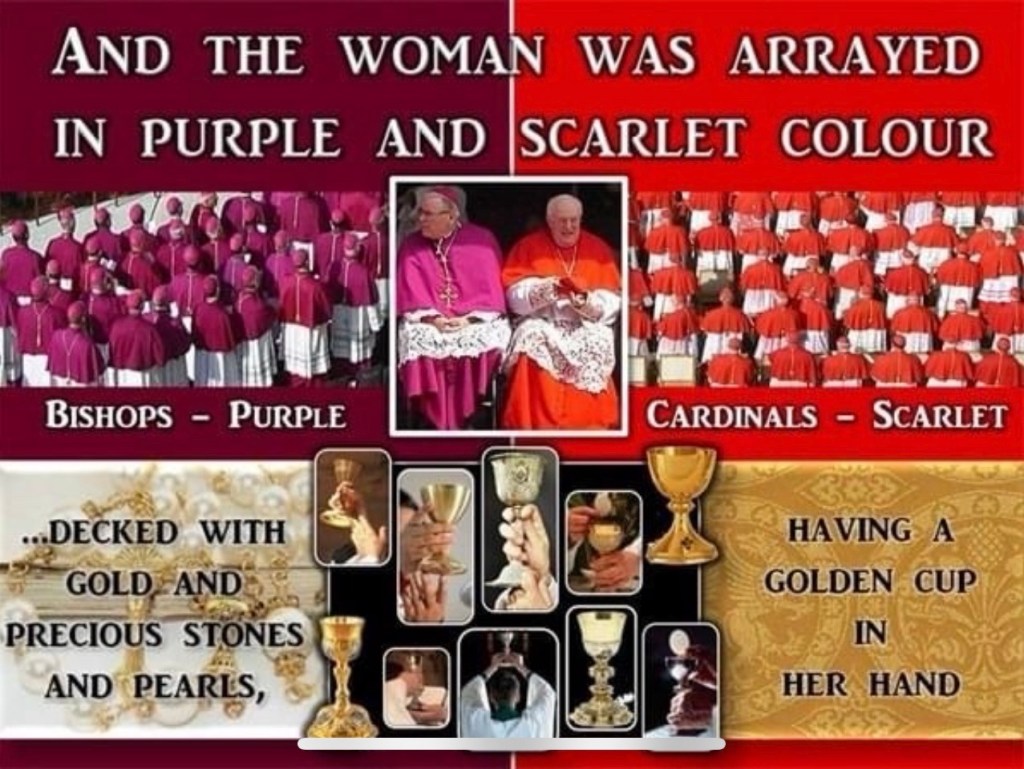
It’s all relatively simple, easily verifiable facts from Church history, yet for some reason most believers haven’t been able to appreciate their significance. Even though over the course of history there’ve been many good people who’ve held that office, it’s widely recognized by historians that there’s also been many Popes who’ve been exceedingly and shockingly corrupt and despotic, which started around the time period referred to as the Papal pornocracy, also called “the Rule of the Harlots,” from 904 to 964 AD, and continued to get worse. Furthermore, that position of authority was the primary persecuting power that had seated itself over God’s Temple (the Church), claiming for himself the very attributes of God and calling himself the “Holy Father;” blasphemously claiming the authority of Christ on earth as the “Vicar of Christ;” taking our focus off Jesus and directing it to himself, to his priests (whom are clothed in “purple” and “scarlet” just as predicted in Revelation 17:4), to dead saints and to Mary; claiming the power to forgive sin (which technically is blasphemy); creating purgatory and indulgences as a way to steal money from simple, unsuspecting, naive believers; teaching the doctrines of demons per 1 Timothy 4:1-3 by placing restrictions on food (not allowing meat on Fridays) and by not allowing his priests and nuns to marry, the consequence being that over the centuries they’ve notoriously ended up sexually abusing and destroying the innocence of hundreds of thousands if not millions, leaving scars that will never fully heal, with the mountain of evidence and cover-ups being so overwhelmingly clear that the Catholic Church has had to pay out billions of dollars after being found guilty in court; and finally, sought to intolerantly murder any who opposed his authority or even merely questioned his false teachings, and therefore is responsible for the deaths of over a million Bible-believing Christians during the Dark Ages and brutally evil Inquisition when it was given precisely 1,260 years to “persecute” and “wage war against the Saints.”
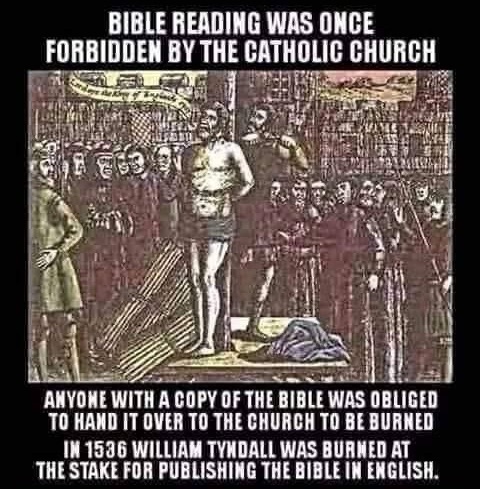
For those that think Revelation might’ve just been about events leading up to 70 AD, it must be acknowledged that the persecution of Christians by Nero pales in comparison to what occurred to them after the fall of the pagan Roman Empire. Many examples of believers who were persecuted during the time period after the fall of the pagan Roman Empire by that “position of authority” over the Church are recorded in Foxe’s Book of Martyrs, and a few that we should be intimately aware of are: John Huss, William Tyndale, Jerome of Prague, Bishop Ridley and Bishop Latimer, Archbishop Cranmer, the persecution of Waldenses, the persecution of Albigenses, and the cruel, premeditated betrayal and murder of many thousands of innocent Protestants during the St. Bartholomew’s Day Massacre, which afterwards was celebrated and commemorated by Catholics. It’s a religion that has true Christians in it, yet it was the supremely powerful religion that had undeniably persecuted us and had killed over a million people during its 1,260 years, therefore the Bible says to them, “Come out of her, my people, lest you share in her sins, and lest you receive of her plagues,” (Revelation 18:4). Ultimately, and this is very important, even though they persecuted us for centuries, as Christians we must be known for having love for one another and forgive them for what they’ve done (Matthew 6:14, John 13:34-35, Ephesians 4:32, Colossians 3:12-13). “Never take your own revenge, beloved, but leave room for the wrath of God, for it is written: ‘Vengeance is Mine; I will repay,’ says the Lord,” (Romans 12:19). Again, we must instead show love and forgive.
The persecution that our Bible believing ancestors endured was precisely what God was warning us would happen; easily verifiable facts of history which match God’s prophecies perfectly. Sadly, absolutely no one from our generation would ever believe it’s all that simple of an answer until they take the time to study “the Traditional Interpretation” and Church history and thoroughly compare it to the prophecies found throughout Scripture to see that every single piece of the puzzle fits perfectly. Yet even then it’s still quite shocking, surprising and is difficult to admit for fear of sounding delusional or intolerant. It’s also difficult to admit because our generation has been conditioned to believe in a superpowerful bad guy that doesn’t appear until the End. Yet it simply isn’t good for people to remain blind and ignorant of verifiable facts from Church history, but instead it’s valuable and healthy to become curious and to examine what our ancestors documented for us to see if the pieces of the puzzle fit. Rather than relying on today’s supposed “experts” who seem to merely be looking for ways they can create “the new flavor of the week,” we should instead note that many still respect Charles Spurgeon, and after he examined hundreds of commentaries he declared that E. B. Elliott wrote the gold standard for interpreting Revelation. Elliott’s commentary is one of many which documented the same consistent version of “the Traditional Interpretation,” and a link to a free abridged copy can be found here. Another site has gathered what our ancestors documented, and those past fulfillments are highly regarded, (but that site’s views of present and future events are decidedly disputable, as well as some of the numbers of those killed appearing to be quite exaggerated, yet aside from those issues it’s still recommended).
Interestingly, these things have even been obvious to some dispensational Futurists like thebereancall.org’s founder Dave Hunt, and can be seen in his commentaries which are worth analyzing, yet his primary problem is he didn’t realize that the 1,260 years have already ended like our ancestors predicted and documented for us. Instead, he unfortunately thought the rebuilding of the 10 kingdom Roman Empire and its persecution is all still future because he was a Futurist. If the identities of all that’s revealed in Revelation was obvious even to a dispensational Futurist like Dave Hunt, then it shouldn’t be that difficult for us to grasp since it’s what our ancestors had thoroughly documented for us. It’s time for us to wake up from our slumber.
The question of the timing of the Millennium is virtually irrelevant within “the Traditional Interpretation,” and there are many examples of Historicists who’ve held each of the major views of the Millennium. Unfortunately, instead of being aware of the Traditional Interpretation, most of today’s postmillennialists have become Preterists since it becomes easier to be postmill if the vast majority of Revelation had supposedly been fulfilled in the first century. As previously noted in the study on the millennial positions, it’s good for us to be optimistic as opposed to the dour pessimism of Futurism, however, postmillennialism is a system that seems to be too optimistic.

So far we’ve briefly looked into Futurism, Preterism, and the oldest of all “Traditional Interpretation” of Historicism, therefore it’s time look at the newest way to understand the book of Revelation: Idealism (with one specific variety being “modified” Idealism which is the most recent of all and harder to nail down and define due to its newness and because it’s still evolving). Every system recognizes that Revelation contains some degree of symbolism, yet in typical Idealism, Revelation is viewed almost entirely with symbolic or spiritual interpretations, with symbols not referring to specific individuals and historic events but only to typical individuals and events. Specific descriptions in Revelation are instead given vague generalizations applicable to anyone at anytime. For instance, every generation could have an “antichrist” and a “mark of the beast” and any number of individuals, world leaders, or empires who exalt themselves against God could be viewed as the “antichrist,” with those who follow that leader receiving his “mark.” Some part of the church is always going through tribulation, and there will be martyrs in every generation. Essentially, the Idealist interprets Revelation as merely the ongoing struggle between God and His people versus Satan and those who follow him. Honestly, it’s not a bad way to look at the book of Revelation, especially for someone who doesn’t want to be confronted with certain specific elements. It’s not bad to focus on overall themes, however, Idealism is clearly missing out on dealing with some very specific key details that need to be evaluated rather than skipped over and ignored.
While our modern-day Idealism is much newer than the three other major views, it’s also described as being somewhat difficult to distinguish from the heavily criticized “allegorizing” approach of the Alexandrians (Clement and Origen). It’s often attributed to the liberal ideology of 19th century German theologians and is typically mixed with aspects of Futurism to make it more palatable to the currently popular imaginations of supposedly dramatic End time events. Yet one major problem with Idealism, as noted by all of the other more well established systems, is that there are very specific events being referred to, and Revelation opens up in the very first verse establishing the historical character of the book: “things which must shortly take place.” And a few chapters later it reiterates: “what must happen after these things” (Rev 4:1).
Revelation is a prophecy:
“…I am your fellow servant, and of your brethren who have the testimony of Jesus. Worship God! For the testimony of Jesus is the spirit of prophecy,” (Revelation 19:10)
In recognizing that it’s a prophecy, we must realize that we simply don’t interpret Old Testament “prophetic” books in an idealist manner. They were written to specific people in a specific time and place, often referring to specific imminent judgments and promising a time of restoration in the distant future. Therefore, Revelation isn’t merely about generic “concepts of good and evil.” Certainly, good and evil is an important theme, but just like in the book of Daniel, God’s prophecies have been manifested in real, concrete and easily verifiable events in history, and the only way to figure out which events is to “use Scripture to interpret Scripture.” Furthermore, some of those specific details which’ve already been fulfilled as predicted were taught in commentaries written by the early Church that had been directly taught by the Apostle John, which we’ll look into in the next study.
Peter Leithart notes that Idealism “is not … consistent with the way biblical prophecy works. Isaiah describes Jerusalem, not some generic city of man, as Sodom, and so does Ezekiel. Daniel sees beasts coming from the sea, and the beasts are identifiable kingdoms (Babylon, Persia, Greece, Rome). Daniel sees a goat racing over the land without touching the ground. It crashes into a ram with two horns and shatters the ram’s horns (Daniel 8:5-8). That is not a generic portrait of “conquest.” It is Alexander’s conquest of the Persians. … John is not referring to … some transcendent concept or class of “harlot-city” of which there are many specific instances. He refers to a real harlot city, one that existed in his own time.” (Leithart, International Theological Commentary, 1:12).
Furthermore, regarding that specific “harlot city,” rather than Babylon merely referring to “the evil world system” as Idealism would like for us to think, as we’ve already noted, the majority of scholars, even since the time of the early Church, have always known that Babylon refers to Rome. Babylon is the code word for Rome, and we find that code word directly used in Scripture:
“Your sister church here in Babylon sends you greetings…” (1 Peter 5:13).
That isn’t referring to the literal land of Babylon: “the evidence indicates that it is very doubtful whether Peter worked in this area, especially in light of the notation in the Talmud to the effect that Christians did not live in the vicinity until the third century,” (O’Connor, Peter in Rome, p.16). Instead, Eusebius, who was the first historian of the Church, documented that Peter was writing from Rome. He based that statement on the authority of Clement of Alexandria and Papias, Bishop of Hierapolis, which was also the view of Jerome who wrote in the eighth chapter of his De Viris Illustribus that: “St. Peter also mentions this Mark in his First Epistle, while referring figuratively to Rome under the title of Babylon.” That Babylon was the code word for Rome wasn’t ever questioned until Erasmus of Rotterdam (1466-1536 AD), who was the first writer on record to explore something other than what had been documented by the early Church. See further studies here and here.
Therefore, as the relatively recent and novel approach, Idealism has been noted as being the least supportable based on genre considerations, whereas all other systems see very specific places and events being predicted.
Idealism in its various forms is essentially a surface level overview of what’s been going on and the direction we’re headed (with some forms having a greater amount of Futurism than others) as we await Christ’s final victory and the establishment of the New Heaven and Earth. Ultimately, again, that’s not really a bad way to try to understand Revelation, seeing merely vague, generalized, non-specific concepts. Interpreting it this way shelters people from needing to deal with the realities of our world. For a good percentage of common believers, that might be a sufficient depth to be revealed, however, it skips over the very specific information that had empowered our ancestors. Yet since those times have already been fulfilled, then to some degree our generation might not need to deal with those emotional facts. However, for those Christians who are mature enough and who actually take the time to learn what our ancestors knew, they will be rewarded with the empowerment of a deeper knowledge of the Church’s struggle and victory, seeing how God has been fighting for His Church and fulfilling His prophecies one by one during these last 2,000 years, and will be able to appreciate just how much has already been fulfilled. What our ancestors knew has been almost completely hidden from our generation, and it truly does make you stop and wonder why. Perhaps it’s because only mature Christians can handle the truth and will take the time to actually learn what God has fulfilled?
When weighing the evidence between those extremes (all future, versus all past, versus merely symbolic) as we’ve noted before, the Truth is instead usually somewhere in the middle.
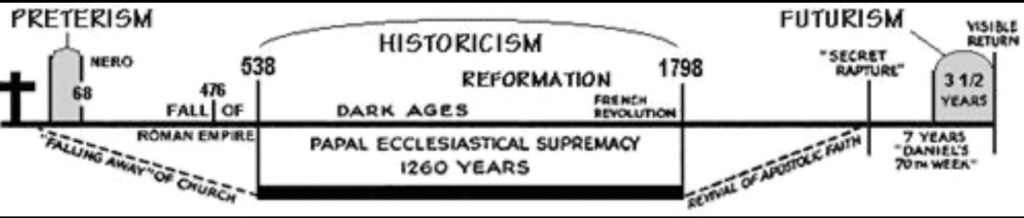
(While the time allotted for the “Little Horn” of Daniel 7 to persecute Christians was from 538 AD-1798 AD, our ancestors knew there were many other predictions that took place outside of that time period, including accurately predicting events that occurred after 1798 AD)
Therefore, is it healthy for people to continue believing Futurism which says the world will become a near hell on earth for “7 years of great tribulation” sometime in the future? Is that what our ancestors believed in their “Traditional Interpretation?” Ultimately, the unfortunate outcome of all of the other systems (Futurism, Preterism and Idealism) is that it makes us oblivious to the sacrifices made by millions of our ancestors and all that they documented for us. Those other systems also make us unaware of the need to ever attempt to examine what might’ve already been fulfilled during Church history. In constantly looking for “the new flavor of the week,” most people never bother to even attempt to appreciate the quality of what they see as plain vanilla Church history. They unfortunately only seem to be searching for what’s shiny and new, and miss out on something huge.
And now, from what the Bible describes about the End, is there even any room for “7 years of great tribulation?” Because it’s so important in answering that question, here again is what Jesus taught about the End in the parable of the wheat and tares:
“The servants said to him, ‘Do you want us then to go and gather them up?’ But he said, ‘No, lest while you gather up the tares you also uproot the wheat with them. LET BOTH GROW TOGETHER UNTIL THE HARVEST, and at the time of harvest I will say to the reapers, ‘First gather together the tares and bind them in bundles to burn them, but gather the wheat into my barn,’” (Matthew 13:28-30).
Jesus then gives the explanation in verses 39-41:
“the harvest is THE END of the age, and the reapers are the angels. Therefore as the tares are gathered and burned in the fire, so it will be AT THE END of this age. The Son of Man will send out His angels, and they will gather out of His kingdom all things that offend.”
It’s important to notice that we all grow together until the End, and according to that passage, interestingly it’s the ones who offend that are gathered and taken away, while the Saints are gathered and then protected in the “barn,” (whatever that might mean).
Next, we see in Matthew 24:37–39 that things at the End will be somewhat like they are today and that everything will seem somewhat normal:
“as the days of Noah were, so also will the coming of the Son of Man be. For as in the days before the flood, they were eating and drinking, marrying and giving in marriage, until the day that Noah entered the ark, and did not know until the flood came and took them all away,” (Matthew 24:37–39).
The account in Luke 17:26-29 gives us even more information:
“as it was in the days of Noah, so it will be also in the days of the Son of Man: They ate, they drank, they married wives, they were given in marriage, until the day that Noah entered the ark, and the flood came and destroyed them all. Likewise as it was also in the days of Lot: They ate, they drank, they bought, they sold, they planted, they built; but on the day that Lot went out of Sodom it rained fire and brimstone from heaven and destroyed them all.”
Therefore, that’s what it’ll be like on the final day before this current Heaven and Earth is destroyed: we will eat and drink, people will be getting married, we will buy, sell, plant, and build. Completely not expecting that we might be at the End. We will all grow together, going about our routine daily lives until Jesus returns, not even realizing how close we were to the End. These passages don’t seem to leave any room for “7 years of great tribulation” at the End. They prove that Jesus’ return will be like Noah’s time, where the flood was the end of that old world. You were either safe in the ark (or the “barn” analogy in the parable of wheat and tares) or you perished under the wrath of God.
Most scholars teach that the book of Daniel was essentially a prerecorded history book, with God revealing detailed history before the events took place. Our ancestors believed that Revelation was also a similar history book, full of events which started after the fall of Jerusalem, progressing through the Church age, then finally concluding with the 2nd advent of Christ. In looking at Revelation as a history book (His-story) written in advance, it’s interesting to again note in verse one of chapter one precisely when these things were to begin taking place:
“The Revelation of Jesus Christ, which God gave Him to show His servants—things which MUST SHORTLY TAKE PLACE,”
and verse 2 declares, “for THE TIME IS NEAR,”
and then the final chapter of Revelation confirms, “And the Lord God of the holy prophets sent His angel to show His servants the things which MUST SHORTLY TAKE PLACE.”
Therefore, if Revelation isn’t primarily centered around the End, but instead is about events that would start taking place after 95 AD, then wouldn’t it be a worthwhile pursuit to study Church history to evaluate things that have already been fulfilled, and see what pieces might fit into the timeline of Revelation?
Unfortunately, the system of interpretation of our ancestors has been misunderstood by most of our current leaders, therefore our leaders either completely ignore the “Traditional Interpretation” or misrepresent it and only make strawman arguments against it, making up and criticizing things that our ancestors didn’t even believe. Yet their actual beliefs have never been disproven or debunked, and many stale, invalid arguments against them have been thoroughly refuted, such as this study written over a century ago. Rather than thinking Revelation was merely describing what occurred in 70 AD, or thinking it was merely 7 years at the End, our ancestors instead knew that Revelation was accurately foretelling what was going to occur during the Church age, as God has been fighting for His Church and fulfilling His prophecies one by one, just like how the book of Daniel had symbolically predicted specific and real events which had taken place over many centuries. The knowledge of those facts of Church history led to our ancestors’ powerful and unstoppable faith in Christ and His Word, which motivated them to endure intense persecution and gave them the ability to accurately predict even the exact years of events that’ve already been fulfilled, as God has already been punishing those who had persecuted our ancestors.
The “Traditional Interpretation” of our ancestors is the ONLY system that’s ever been able to accurately and consistently predict events that actually came to pass, and that should be an exceedingly strong indicator to us of the validity of their system. Only someone “rightly handling” the Word of God is able to make predictions that actually came to pass, and the only way they were able do that was by using “Scripture to interpret Scripture.” Not by using their imaginations like Futurists do in their popular fiction books. Our ancestors instead used Scripture to define itself, and the only way to understand prophecies is to look back at the Old Testament for the definitions of the symbols used in Revelation. Historicists might see varying amounts of recapitulation in Revelation, yet where they all agree is in realizing that the Seals, Trumpets and Judgement Vials were all in chronological order. By now those have almost all been fulfilled, and centuries ago our ancestors used that roadmap before certain events had taken place to be able to accurately predict what would occur next. They didn’t think they were near the End (as some falsely accuse them), but instead they realized what all would need to happen next before the End could be possible.
The Seals, Trumpets and Judgement Vials are such an incredibly precise fit with what’s occurred during the last 2,000 years of history. We unlock each symbol by looking back in the Old Testament to find the meaning, which simply must be seen to be believed, and once you do, it will truly blow you away. Again, it’s so precise that it allowed our ancestors to accurately know exactly what was going to happen next. Learning about the faith of our ancestors and learning about what they believed should still motivate us even in this day and age, and the accuracy of God’s foreknowledge should amaze us. Again, Charles Spurgeon declared that E B Elliott wrote the gold standard for interpreting Revelation, and a video series loosely based on that magnum opus work can be found here, and here’s a link again to Elliott’s free Historicist commentary as well as E. P. Cachemaille and several works by Henry Grattan Guinness can be found within the free Lutheran Library, such as History Unveiling Prophecy (the links to request a download are at the top of the pages).
To conclude, it’s truly amazing to be able to see God’s hand at work throughout these last 2,000 years. Are we brave enough and strong enough to study Church history and examine the pieces of the puzzle, to see what might’ve already been fulfilled? If the pieces fit, then they fit, but if not, then we can just toss them aside. But our ancestors were literally dying to tell us what they knew. Perhaps we should listen to their voices. They told us nothing else could ever possibly come along to fulfill again what had already been perfectly fulfilled the first time. Rather than erroneously thinking there might be “7 years of great tribulation” at the End, our ancestors instead knew that the 1,260 days were part of the Seals, Trumpets and Judgement Vials which were 1,260 “years” of trouble, knowing the Biblical “day for a year” principle of prophecy. Their commentaries were never disproven, but instead the sensationalism of Futurism simply caught people’s attention, and each generation that came along next never relearned what our ancestors knew. Rather than being fearful of “7 years of great tribulation” at the End, wouldn’t it be healthy to instead evaluate what our ancestors witnessed during very real, concrete and verifiable world history and Church history?
 “Helping People See Jesus and Exploring All That He Has Fulfilled”
2 thoughts on “What if there isn’t “7 years of great tribulation” at the End? (A look into Preterism, Historicism and Idealism)”