History Meets Prophecy
The Four-Kingdom Framework in Daniel: Babylon → Medo-Persia → Greece → Rome
1st Advent → Christ’s Kingdom
An overview of Daniel shows there would be four kingdoms that would rule over Israel: the Babylonian Empire, followed by the Medo-Persian Empire, then the Greek Empire, and finally the fourth which was in power during the ministry of Jesus: the exceedingly powerful Roman Empire which even ruled over Jerusalem. That’s all part of the well established “Traditional Interpretation.” That’s the majority view which had always been obvious even going all the way back to Jewish commentaries. Only someone with an agenda would dare attempt to imply otherwise. Those were the four kingdoms, and the fifth is the Kingdom of King Jesus which is in its inaugural form that will someday be replaced by the final consummated form in the New Heaven and Earth.
Because that order of kingdoms plays such a large role in Daniel, and we know Revelation contains many similarities with what’s found in Daniel, then we should naturally expect to find the same narrative of Empires that started in Daniel to carry over into Revelation, just as our ancestors had documented for us. It’s a consistent order, rather than randomly being rearranged.
Since this order of Empires is so important, it’s now time to begin examining its introduction in Daniel 2, and we should especially note the vast usage of symbolism that God used throughout the book of Daniel to predict those already fulfilled events.
The Statue of Empires (Daniel 2)
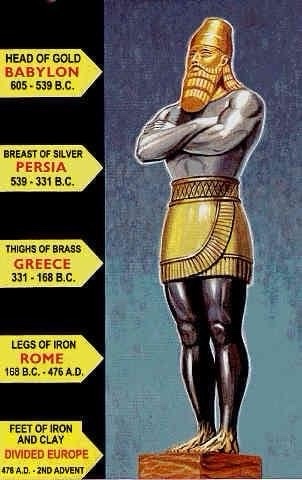
This is the dream and it’s interpretation that Daniel gave to Nebuchadnezzar:
“This image’s head was of fine gold, its chest and arms of silver, its belly and thighs of bronze, its legs of iron, its feet partly of iron and partly of clay. You watched while a stone was cut out without hands, which struck the image on its feet… and became like chaff from the summer threshing floors; the wind carried them away so that no trace of them was found. And the stone that struck the image became a great mountain and filled the whole earth.”
“Now we will tell the interpretation… the God of heaven has given you a KINGDOM… you are this head of gold. But after you shall arise another KINGDOM inferior to yours; then another, a third KINGDOM of bronze, which shall rule over all the earth. And the fourth KINGDOM shall be as strong as iron… Whereas you saw the feet and toes, partly of potter’s clay and partly of iron, the kingdom shall be divided… And in the days of these kings the God of heaven will set up a KINGDOM which shall never be destroyed…,” (Daniel 2:31–44).
The order of the kingdoms clearly started with Nebuchadnezzar’s Babylonian Empire, and then “the handwriting on the wall” informed Belshazzar that his kingdom was about to end:
“Your KINGDOM has been divided, and given to the Medes and Persians,” (Daniel 5:28).
Therefore, according to that passage, the Babylonian Empire was replaced by the “Medes and Persians,” and it was a combined kingdom.
Medo-Persia and Greece Identified (Daniel 8)
For the identification of the next phase which was the Greek Empire that overtook the Medo-Persian Empire, especially notice the symbolism utilized, rather than straightforward descriptions:
“…a male goat came from the west… Then he came to the ram that had two horns… The ram which you saw, having the two horns—they are THE KINGS OF MEDIA AND PERSIA. And the male goat is THE KINGDOM OF GREECE,” (Daniel 8:5–6, 20–21).
First, notice that the terms “kings” and “kingdom” were used interchangeably in those two passages. In referring to Media-Persian Empire, the word used was “Kings,” and yet when referring to the Greek Empire, the word used was “Kingdom.” Thus, those words are interchangeable. Next, rather than referring to a literal goat or ram, the “two” horned ram was representative of the divided Medo-Persian Empire and the goat was from the kingdom of Greece and represented Alexander the Great.
Alexander the Great and the Diadochi—In the prophecies about this third phase, the Greek Empire, it’s been obvious to historians that Alexander the Great quickly and powerfully conquered the Persians in a brilliant series of battles. Alexander mysteriously died at the young age of 32, and after his death his empire was divided into “FOUR” dynasties. Alexander’s top FOUR GENERALS, as part of the Diadochi, fought for control. Ptolemy, Antigonus, Cassander, and Seleucus were the last remaining at the end of “the Wars of the Successors,” forging four dynasties that lasted several centuries.
Here’s another passage that predicted those historical events:
“Then a mighty king shall arise… And when he has arisen, his kingdom shall be broken up and divided TOWARD THE FOUR WINDS of heaven, BUT NOT AMONG HIS POSTERITY…,” (Daniel 11:3–4).
That’s exactly what happened: “….divided…not among his posterity,” which means it wouldn’t go to any of his descendants. It instead went to four generals as we just saw, fulfilled exactly as predicted, which we’ll evaluate more in our next study.
Daniel 7: Beasts as Identified Empires
The sequence of kingdoms in Daniel 2 had portrayed the four Empires as metals which were part of a statue, yet the sequence we’ve seen in Daniel 7 portrayed those same Empires as “beasts.” The description of “beasts” was simply another similar way of portraying those exact same four Empires.
Knowing all of this, when examining Daniel 7, we’ve seen that:
- The first “beast” was the Babylonian Empire
- The second “beast” was the Medo-Persian Empire
- The third “beast” was the Greek Empire
- The fourth “beast” was the Roman Empire
Even dispensational sources acknowledge this identification, as summarized in the following explanations (quotes preserved from gotquestions.org), which identify Babylon, Medo-Persia, Greece, and Rome in order. It will be significant to note that these first three “beasts” are also repeated in Revelation 13 to describe the culmination of what was to precede the fourth Empire.
Rome During the Ministry of Christ—As we’ve seen, what came next after the Greek Empire was clearly the exceedingly powerful Roman Empire. Jesus was born during the reign of the Roman Empire, specifically during the height of “Pax Romana,” the roughly 200-year period identified as the golden age of Roman Imperialism, notable for relative peace, order, and prosperity, from 27 BC to 180 AD.
The Stone and the Fifth Kingdom—During the time of that fourth kingdom, “in the days of these kings” (Daniel 2:44), God was to set up His Kingdom, the fifth kingdom, which would start out small like a mustard seed (Matthew 13:31–32) and would grow to become a great mountain.
During the reign of the fourth kingdom there was going to be a “stone,” which we now know was Jesus who was the “cornerstone” (1 Peter 2:4–8), who would eventually break and consume the remnants of the other kingdoms. We see that confirmed in Matthew 21:44:
“And whoever falls on this STONE will be broken; but on whomever it falls, it will grind him to powder.”
Christ’s Kingdom was inaugurated during the Roman Empire, exactly as Daniel foretold.
Transition to the Next Study
Up to this point, Daniel has identified who the empires are, when they appear, and when God’s Kingdom begins. What Daniel has not yet explained is what happens after Rome begins to fragment, or how power continues within that fourth kingdom.
That development — including horns, internal power shifts, persecution, and prophetic timeframes — is where Daniel’s prophecy intensifies.
That is the focus of the next study.
 “Helping People See Jesus and Exploring All That He Has Fulfilled”
2 thoughts on “The Four Empires and God’s Kingdom”