
The Connection Between the Four Empires and the Division of Rome—Daniel 7 and Daniel 2’s prophecies converge at the point of Rome’s division. Daniel 7:12 highlights the continued existence of the former empires even after their political supremacy had ended. This distinction is key to understanding how the ten kingdoms emerged after the fall of Rome and how they fulfill the prophecy laid out in Daniel. As we see in Daniel 7:7, the Roman Empire, distinct from the earlier kingdoms, divided into ten horns or kingdoms, which coexisted with the remnants of the ancient empires.
The Division of the Roman Empire—The Roman Empire ended up dividing into the Western and Eastern halves, which could possibly be depicted as the two legs of the statue. Yet remember that the previous kingdom of Greece had been depicted as the “thighs,” even though it wasn’t literally two separate kingdoms. While the empire was divided into two halves, all 10 kingdoms from the prophecy emerged within the Western half. The fall of the Roman Empire in 476 AD marks the collapse of the Western Roman Empire, when its political control disintegrated and its vast territory fractured.
Technically, the fall of the Roman Empire in 476 AD can be referred to as the fall of the “Western” Roman Empire, or simply “the fall of Rome.” It was the loss of central political control within the Western Roman Empire when the ability to enforce its rule ended and its vast territory divided.
Regarding the question of how literally we’re to interpret the body parts of the image, and whether ten toes might oddly appear on only one foot, see this commentary from Henry Grattan Guinness:
“We read in Daniel 7:12 that the three earlier beasts did not cease to be when the fourth arose. ‘Their dominion was taken away, yet their lives were prolonged for a season and time.’ That is, the three first empires are said to co-exist with the fourth after their dominion has ended. This proves that they are regarded as distinct in place as well as in time. They continue to be recognized as territorial divisions of the earth after the disappearance of their political supremacy.”
“Now the Eastern Empire of Rome occupied precisely the same territory as the Grecian Empire, or ‘thighs of brass.’ It cannot therefore be one of the legs of iron, or be regarded as forming any part of the empire proper and peculiar to Rome. The ten horns of the fourth empire must none of them be sought in the realms of the third, second, or first, but exclusively in the realm of the fourth, or in the territory peculiar to Rome, and which had never formed part either of the Grecian, Medo-Persian, or Babylonian empires.”
“The master mind of Sir Isaac Newton perceived this long ago! He says: ‘Seeing the body of the third beast is confined to the nations on this side the Euphrates, and the body of the fourth beast is confined to the nations on this side of Greece, we are to look for all the four heads of the third beast among the nations on this side the Euphrates, and for all the eleven horns of the fourth beast among the nations on this side of Greece. Therefore we do not reckon the Greek Empire seated at Constantinople among the horns of the fourth beast, because it belonged to the body of the third,’” (Fallacies of Futurism, p.16-17, Guinness).
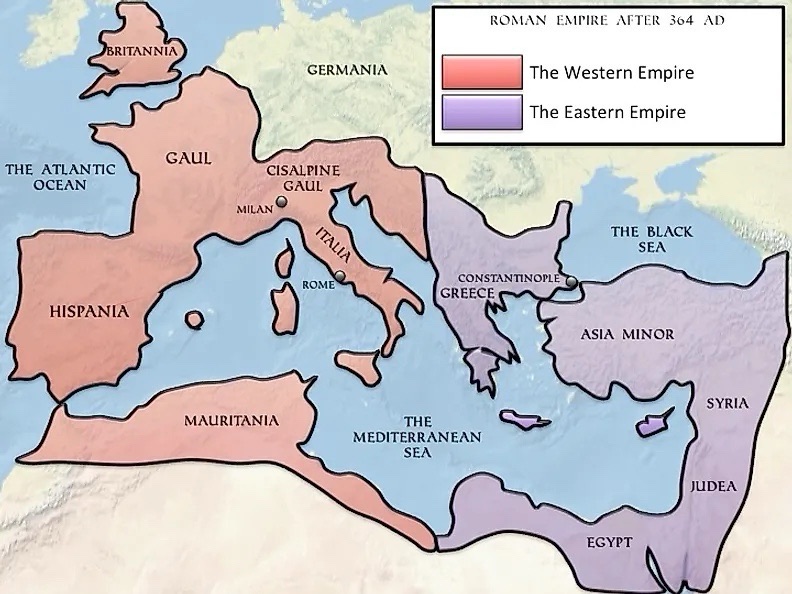
Daniel 7:24 tells us that the 10 kingdoms are said to “arise from” the fourth kingdom, not necessarily out of the whole area it ever covered, but simply from it. We see those 10 kingdoms (which appear not only in Daniel but also in Revelation) aren’t to be found from the widest area of the Roman Empire, but instead only from the western part which had never been controlled by Greece, because what is know as the Eastern Roman Empire is actually part of the former Greek Empire.
“The successive metal portions of the Great Image [from Daniel 2] denote successive additions of territory as each Empire is formed, and also a transfer of supreme power to the new Empire. Each metal as it attains supreme power rules also over the portions of the Image above it. Thus the silver portion denotes the fresh territory added by the Medo-Persian Empire to that of Babylon, and the transfer of power over both to the new Empire thus extended. So with the brass. Similarly the iron portion of the Image denotes the fresh territory of the Western Empire of Rome which was added to the Eastern territories symbolized by the previous metals; also that the supreme over of the whole was to be transferred to the new Empire of Rome. Hence it is clear that since the Ten Toes belong to the iron portion of the Image, the kingdoms they symbolize are to be sought, not in the Eastern territories of the previous portion, but only in that part of the Roman Empire which was not included in the Grecian brass, or the Medo-Persian silver, or the Babylonian gold; that is to say, only in the Western Roman Empire,” (The Visions of Daniel and Revelation Explained, E. P. Cachemaille, p. 432).
While its legitimacy lasted for centuries afterwards and its influence remains today, the Western Empire never had the strength to rise again and fully merge together, just as predicted:
“…they will not adhere to one another, just as iron does not mix with clay,” (Daniel 2:43).
Meanwhile, the Eastern or “Byzantine” Roman Empire survived and remained for centuries as an effective power, yet it too lessened in strength as had also been predicted. Interestingly, our ancestors noted that there were predictions of the decline of the Eastern Empire in Revelation, and they were able to accurately predict those events before they occurred.
The Role of Edward Gibbon: Secular Confirmation of Prophecy—To examine the fall of the Roman Empire without bias, we turn to the influential secular historian Edward Gibbon. Known for his criticism of organized religion, Gibbon’s The History of the Decline and Fall of the Roman Empire provides a thorough, non-Christian account of the empire’s collapse. Notably, his work was criticized for its scathing view of the Christian church and its antagonism toward Christian doctrine, leading to the banning of the book in several countries. This context underscores that Gibbon had no interest in fitting his findings to Christian prophecy, offering instead a scholarly perspective on the fall of the Roman Empire.
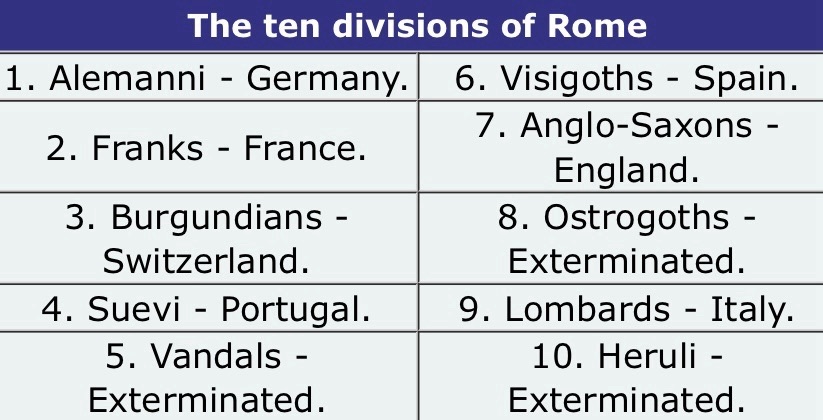
In that thoroughly researched account of history we learn that the Western Roman Empire divided into ten separate kingdoms: Alemanni, Franks, Burgundians, Suevi, Vandals, Visigoths, Anglo-Saxons, Ostrogoths, Lombards, and the Heruli. History is also unmistakable as to who uprooted the three exterminated kingdoms. It can be attributed to one power only, and that power was the “Little Horn” of Daniel 7 which is also synonymous with the “beast” in Revelation. That power was the position of authority that rose up over the Church which is the Temple of God. Quotes from Gibbon’s work regarding those ten kingdoms can be found here.
The Debate on Literal vs. Symbolic Kings—As for the debate on whether these are merely ten consecutive literal ‘kings,’ the text clearly states:
“…a little one, coming up AMONG them,” (Daniel 7:8).
In order for another king or kingdom to come up AMONG them, they all had to exist at the same time. We’ve already seen that Early Church theologians such as Cyril had noted that they were to reign “all about the same time.” That matches history perfectly; the kingdoms all existed at the same time. A certain position of authority over the Church (the Temple of God) then uprooted the Vandals, the Heruli and the Ostrogoths as they had opposed his authority. And now, as a result, none of those three kingdoms currently exists today.
The 1,260 Years of Persecution—Lastly, we’ll note that in both Daniel 7 and Revelation 13, the opportunity would be given for that position of authority over the Church to “persecute” and “wage war” against Christians for a length of time referred to as 42 months, which is the same as 3.5 years, which is also the same length of time as 1,260 days:
“I was watching; and the same horn was MAKING WAR AGAINST THE SAINTS, and prevailing against them… He shall speak pompous words against the Most High, SHALL PERSECUTE THE SAINTS of the Most High, and shall intend to change times and law. Then the saints shall be given into his hand FOR A TIME AND TIMES AND HALF A TIME,” (Daniel 7:21, 25).
In anticipation of what we’re going to find in Revelation, please consider these verses in Daniel 7 which display the exact same details which are in Revelation 13, and it should be obvious that they’re both describing the exact same thing which arose from out of the fourth kingdom:
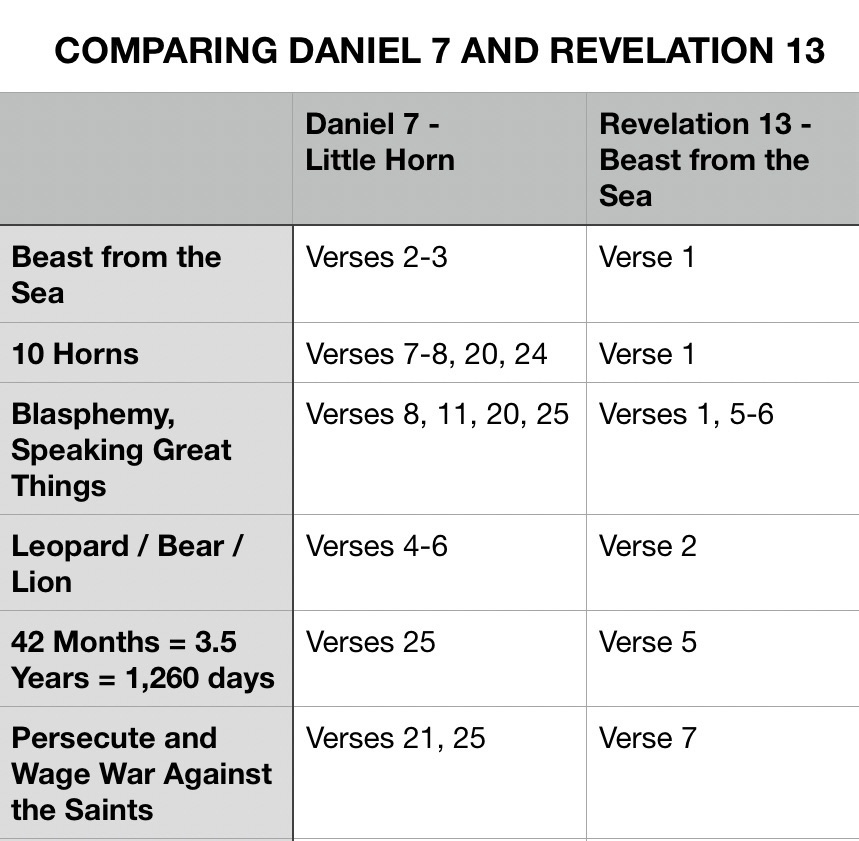
Regarding “making war against” and “persecuting” Christians “for time, times and half a time,” we all now know that “time” refers to a year, “times” would be two years, and half a “time” is half a year, which all together equals 3.5 years. That time period is exactly the same as 42 months, which is the same as 1,260 days (a Biblical “month” has 30 days and therefore 3.5 Biblical “years” has 1,260 days). To avoid confusion, the Bible had rephrased “time, times, and half a time” for us in those other passages which tell us that it’s actually 42 months or 1,260 days. It’s all referring to the exact same thing, and what it had referred to eventually became painfully obvious to our ancestors. Our ancestors recognized the Biblical “day for a year” principle of prophecy taught in Numbers 14:34, Ezekiel 4:6 and Daniel 9, therefore they knew that the persecution wouldn’t just be for 1,260 days, but rather, it would be 1,260 years, which fortunately have by now already been fulfilled.
That specific time of persecution was to take place “after” the restrainer was removed, which means it would rise up and begin shortly after the fall of the pagan Roman Empire which fell in 476 AD. (For a glimpse of when it officially began, see this and this).
We’ve seen that Revelation wasn’t about the destruction of Jerusalem, but rather, it reveals what would occur “after” 70 AD. And any persecution that had occurred before 70 AD pales in comparison to what occurred during these last 2,000 years of Church history, and especially what occurred during the foretold 1,260 years. It’s absolutely fascinating to learn what our ancestors recognized about Church history and recorded for us in their commentaries.
Transition to Revelation and the Traditional Interpretation
As we conclude our study of the Book of Daniel, we have seen how the prophecy of the 1,260 years of persecution was fulfilled in the rise of the position of authority claiming to rule over the Church, which occurred after the fall of the Roman Empire in 476 AD. This period of time, symbolized by “time, times, and half a time” in Daniel, mirrors the persecution described in Revelation, where the same time frame is reiterated, emphasizing the prolonged suffering of the saints under the rule of the “beast” and the power it wielded over God’s people.
In the next semester, we will shift our focus to Revelation, where the prophecies introduced in Daniel find their climactic fulfillment. Just as Daniel set the framework for understanding the 1,260 years of persecution, Revelation expands on this and reveals the ultimate victory of Christ and the final judgment. We will explore how the Traditional Interpretation aligns with these prophecies, showing how the historical record of persecution and the unfolding of God’s kingdom are intricately woven together in both the Old and New Testaments.
By continuing our study of Revelation, we will deepen our understanding of God’s sovereignty over history and how His plans, once concealed, have now been revealed to us, offering a more complete picture of the future that was always part of His divine roadmap.
 “Helping People See Jesus and Exploring All That He Has Fulfilled”
2 thoughts on “The Fall of Rome, the Rise of the Little Horn and the 1,260 Years of Persecution”