Understanding the 1,260 years has been crucial in grasping the broader narrative of prophetic fulfillment in the Bible. This period represents one of the most significant phases in Church history, marked by the rise of Roman papal authority and its persecution of Christians. From the fall of pagan Rome to the rise of Papal supremacy, the 1,260 years fulfilled a key component of prophecy, as detailed in Daniel and Revelation. In Daniel 7, the “Little Horn” symbolized the papacy, which held dominion over Europe, persecuted true believers, suppressed biblical truth, suppressed the translation and ownership of the Bible, and exercised considerable political power, all while claiming divine attributes reserved for God alone. That reign peaked during the Middle Ages, only to be undermined in the modern era.
The 1,260 years, symbolized by the 42 months or 1,260 days in Scripture, began in 538 AD with the papacy’s rise to political supremacy and extended through to 1798 AD, when the Papacy’s temporal power came to an end, although its influence would later increase after the Lateran Treaty of 1929. This period of persecution and oppression against God’s people was prophesied in several places in the Bible, including Daniel 7:25 and Revelation 13:5. The events we will explore in our upcoming studies will culminate in a monumental turning point—a pivotal moment in history that marked the fall of powerful forces that had long held dominion, never again to regain the same level of coercive power to persecute the Saints.
Emperor Justinian’s Decree and its Role in the 1,260-Year Prophecy
Before we delve deeper into the 7th Trumpet and the Judgment Vials, it’s crucial to revisit a pivotal moment in history that laid the groundwork for the fulfillment of the 1,260-year prophecy: the decree of Emperor Justinian in 533 AD. Justinian’s decree was more than a formal recognition of the Pope as the head of all Christian churches—it was a legislative turning point that cemented the union of faith and imperial law.
For the first time in history, theological dissent was made illegal and punishable under imperial law. Justinian’s decree gave the Papal system the power to not only wield spiritual authority but also to persecute those who opposed Catholic doctrine. This marked a beginning of Papal persecution—a key aspect of the Little Horn of Daniel and Revelation, which would have authority to “persecute the saints of the Most High” (Daniel 7:25).
However, the decree alone did not mark the full activation of this prophetic period. While Justinian’s decree granted legal authority to the Papacy, it could not be exercised until the last political obstacle was removed. The Arian kingdoms—particularly the Ostrogoths who still controlled Rome—prevented the Papal system from assuming full authority. Prophecy required not just a decree but the removal of rival kingdoms that stood in opposition to the Papal system. The Little Horn had been predicted to first subdue three kingdoms (Daniel 7:8, 20, 24), and the Ostrogoths were the final kingdom to be “plucked up.”
That decisive moment came in 538 AD when the Ostrogoths were finally defeated, and Rome was secured under Catholic control by Justinian’s general, Belisarius. This victory marked the uprooting of all three Arian powers—the Heruli, the Vandals, and the Ostrogoths—exactly as Daniel had foretold. Only after this defeat did the Justinian decree truly take effect, allowing the Bishop of Rome to wield unhindered power—both religiously and politically.
From this point, the Papal system could finally enforce its doctrines by law, punish dissenters, and fully exercise the power that prophecy had linked to the Little Horn. Justinian’s decree thus became not just a formal recognition of Papal authority, but a practical reality—one that allowed the Papal system to now control both the church and state.
For this reason, Historicist interpreters have identified 538 AD as the true starting point of the 1,260-year prophetic period. It marks the moment when Papal authority was no longer just theoretical but was exercised unhindered—a critical juncture when prophecy, already set in motion, could now unfold fully. The prophetic clock did not begin when authority was merely declared, but when it could finally be enforced. As we will soon witness, exactly 1,260 years later, a world-changing event would bring this prophecy to a remarkable fulfillment.
Predictions Pointing Toward 1790
Historically, many interpreters of prophecy predicted the end of the 1,260 years would occur sometime around 1790. However, it’s important to note that these interpreters did not see 1790 as the end of the world. Instead, they simply believed it marked the conclusion of a significant prophetic period—the end of Papal temporal power and the end of it’s ability to “persecute” and “wage war against the saints.” Other prophetic events, such as the unfolding of the remaining Judgment Vials and the final Judgement Day, would still come after this period.
Robert Fleming, in his work “The Rise and Fall of Papal Rome” (1701), predicted that the 1,260 years would end in 1794 and 1848. These two dates stem from a common difference in interpreting the calendar: 1794 was calculated using the solar year (standard in much of the Western world), while 1848 was based on the lunar year. Fleming, however, started his 1,260-year calculation from 533 AD, the year of Emperor Justinian’s decree recognizing the Pope as the head of all Christian churches. This differed from the more accurate 538 AD, when the papacy’s power was truly unhindered after the fall of the Ostrogoths. Fleming’s earlier starting point explains why he arrived at 1794 as the predicted end, a time when the French Revolution played a key role in weakening papal authority.
Drue Cressener (1689) in “The Judgment of God Upon the Roman Catholic Church” wrote that the first appearance of the Beast coincided with Justinian’s recovery of the Western Roman Empire, and predicted that the 1,260 years would end around 1800—a strikingly accurate anticipation of the French Revolution.
Other key prophetic figures, such as William Whiston (1667–1752) and Bishop Thomas Newton (1704–1782), pointed to 1790 or the French Revolution as the culmination of the 1,260 years. Whiston and Newton, both notable scholars in prophetic interpretation, calculated the end of the 1,260 years as occurring around the time of the French Revolution, highlighting the Papacy’s loss of power as a key prophetic event.
Henry Grattan Guinness, in “History Unveiling Prophecy,” referred to Fleming’s predictions and broadened the scope, collecting testimony from many prophetic figures spanning centuries. These figures, including John Napier (1593), Vitringa (1695), and Cressener (1690), all placed the end of the 1,260 years at or near 1790. Guinness emphasized the French Revolution as a critical turning point, citing it as the event that marked the downfall of the Papal system. Guinness also specifically noted that 1798—the year the Pope was taken captive by French forces—was a significant fulfillment of the prophetic period, aligning with historical events that had long been prophesied.
Confirmations of Prophetic Fulfillment—In 1798, Edward King, a Methodist theologian, was among the many who recognized the profound prophetic significance of the events unfolding before his eyes. Reflecting on the history of the Church, King pointed out that 1,260 years earlier, in 538 AD, the Gothic rule over Rome was defeated, and the Pope became the uncontested authority. King wrote with remarkable clarity in “Remarks on the Signs of the Times” (1798): “Just 1260 years ago, in the very beginning of the year 538, Belisarius put an end to the empire of the Goths at Rome, leaving no power therein but the Bishop of that Metropolis.” King’s words resonate deeply, capturing a critical moment in history when Papal reign shifted from a distant religious influence to an entrenched, politically powerful system. King’s insights remind us that this prophecy was not simply theological speculation, but a tangible event that shaped the course of Western Christianity.
King’s observations are mirrored by David Simpson, another Methodist theologian, who also in 1798 highlighted the fulfillment of the 1,260-year prophecy. Simpson emphasized that 1,260 years before, Belisarius had ended the Gothic rule over Rome, leaving the Pope as the sole authority. Simpson’s keen awareness of the unfolding events aligns with his contemporaries’ recognition that what had once been prophecy was now history in the making, confirming the accuracy of the prophecy’s fulfillment in 1798.
Additionally, Albert Barnes (1798–1870), the American commentator, also calculated prophetic timelines based on the 533 AD starting point, arriving at dates that pointed toward the late 18th century. His work reinforced the understanding of this period as a significant prophetic marker.
Similarly, William Cuninghame of Lainshaw (c. 1775–1849), an important figure in early 19th-century prophecy interpretation, utilized the 533 AD start date in his prophetic calculations. He also understood the Papal period—culminating in the French Revolution—as part of the unfolding prophecy, and his work had a lasting influence on later historicist and premillennial authors.
Other key 19th-century figures such as John Gill (1697-1771), J.A. Wylie, and Charles Haddon Spurgeon continued to affirm the 1,260-year prophecy’s fulfillment with significant theological and historical reflections. Gill, in particular, pointed to the papacy’s 1,260-year reign as an era of oppression, laying the groundwork for later historicist views. Wylie, in “The History of Protestantism,” identified 1798 as a critical moment in the fall of Papal power, while Spurgeon, though less focused on specific prophecy dates, also affirmed the prophetic significance of these events in broader Christian history.
Even Henry Edward Manning, an influential Catholic theologian, affirmed in 1862 that the Papacy had indeed ruled for over 1,200 years, further corroborating the 1,260 years prophecy.
The City of Seven Hills and Rome’s Purple and Scarlet
In case it hadn’t already been made abundantly clear, in Revelation chapter 17, God gives one final, unmistakable confirmation of who He intended to punish. With vivid detail and precision, He confirms the identity of the apostate power beyond any reasonable doubt. These details leave no room for ambiguity, for only one religious organization in history fits this description with absolute perfection: the “City of Seven Hills” is unmistakably Rome.
As we continue examining the fulfillment of the 1,260 years and the events corresponding to the Judgment Vials, we must turn our attention to this critical identifier: the “City of Seven Hills,” a phrase mentioned several times in Revelation 17. This is a key marker, and there is no ambiguity—it undeniably refers to Rome. Revelation 17:9 states, “Here is the mind which has wisdom. The seven heads are the seven mountains on which the woman sits.”
Rome’s identity as the “City of Seven Hills” is so universally recognized and well-documented that no other city can truly rival it in this regard. Ancient Roman historians and geographers, including Pliny the Elder, acknowledged that Rome was founded upon the seven hills: Palatine, Aventine, Capitoline, Quirinal, Viminal, Esquiline, and Caelian. These hills are not only essential to Rome’s identity but continue to be recognized today in both secular and theological discussions.
Even the Catholic Encyclopedia affirms this fact: “It is within the city of ROME, CALLED THE CITY OF SEVEN HILLS, that the entire area of Vatican State proper is now confined.” This long-standing geographic and historical fact has been consistently affirmed over centuries, making it undeniable that the “seven mountains” mentioned in Revelation refers directly to Rome.
Furthermore, the woman in Revelation 17, who symbolizes the apostate Church, is clothed in purple and scarlet, riding upon the beast. These vivid descriptions match the attire of the Catholic Church with remarkable precision. According to the Catholic Encyclopedia, the Cappa Magna is a long purple wool cloak worn by bishops, while cardinals wear scarlet robes. Similarly, the Cassock—an ankle-length robe worn by Catholic clergy—is purple for bishops and other prelates, and scarlet for cardinals. These colors, long used by the Catholic Church, perfectly correspond with the imagery found in Revelation 17, reinforcing the direct connection between the apostate Church and Rome.
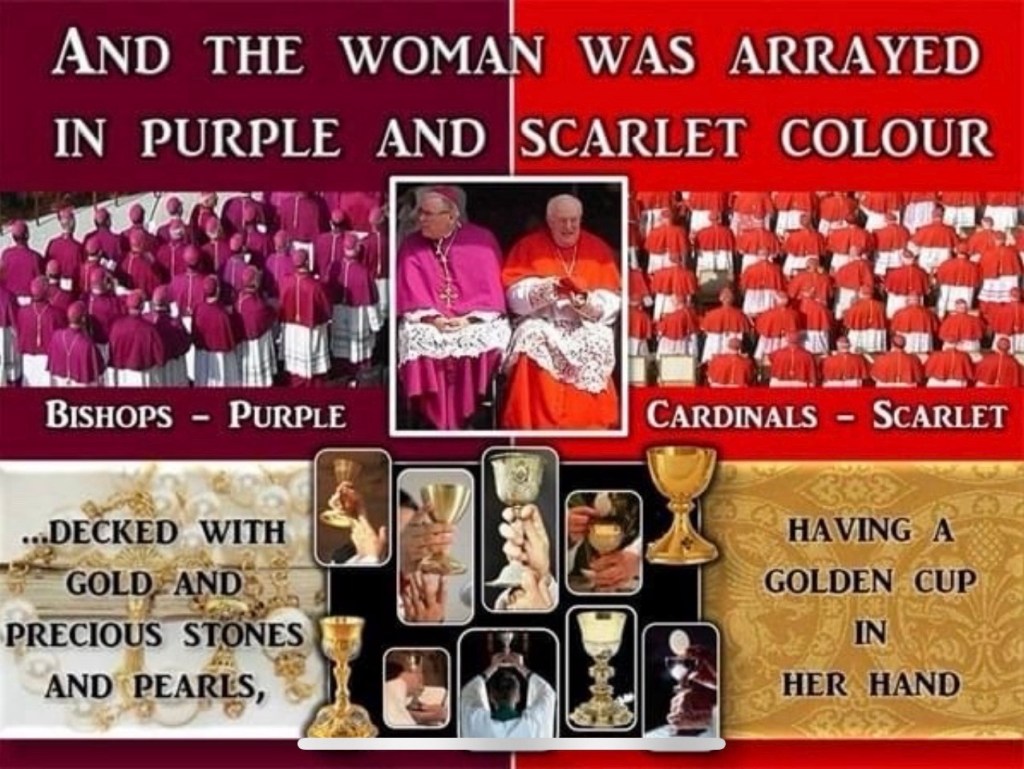
In Revelation, this woman is also described as holding a golden cup, full of abominations (Revelation 17:4). This “golden cup” symbolizes not only the material wealth amassed by the Church but also its spiritually corrupt practices. The Catholic Church’s wealth—accumulated through means such as the sale of indulgences and the forced confiscation of property from those deemed heretics—became infamous throughout history. The symbolic “cup” in Revelation speaks to the unholy alliances the Church forged with political powers and the corrupt ways it wielded its influence, often at the expense of the faithful.
Moreover, Rome’s central role as both the ecclesiastical and political heart of Christendom is underscored by the woman’s position—sitting upon the beast, symbolizing the Church’s reliance on political power to enforce its authority and expand its influence. Throughout history, the Papacy has consistently used its influence over kings and rulers to secure and extend its position—echoing the image of the woman riding the beast. This has been a consistent pattern, making Rome’s identification in Revelation as the apostate Church indisputable.
Rome’s distinctive identity as the “City of Seven Hills,” coupled with its wealth, political power, and ecclesiastical dominance, strongly ties it to the imagery found in Revelation 17. There is no city, past or present, that meets these criteria as precisely as Rome. Well known throughout history—including in the minds of early Christians and prophetic interpreters—Rome has long been recognized as the seat of religious and political authority that rose in opposition to God’s people. This identity has been affirmed across centuries of scholarship and theology, making the connection between the prophecy and the Papacy undeniable. Even dispensational Futurists have been able to make all of these same obvious connections: Rome, the city of seven hills, clothed in purple and scarlet, and holding the cup. The long-standing recognition of Rome’s role—both secular and theological—reinforces the conclusion that the prophecy in Revelation specifically refers to Rome, with its historical and ongoing influence over both church and state.
Connecting the Judgment Vials to God’s Call: “Come Out of Her, My People”
As we transition into the outpouring of the Judgment Vials, it is essential to remember God’s compassionate and urgent call to His people, “Come out of her, my people, lest you share in her sins, and lest you receive of her plagues,” (Revelation 18:4). The Judgment Vials, which represent the final outpouring of God’s wrath upon the apostate Church (Rome), are inseparably linked to God’s call for separation. While the Vials themselves signify the intense judgment poured upon this religious system, the invitation to God’s people to “come out” preceded His wrath. God’s desire is not for His people to share in the judgment, but to heed His call for separation before the plagues were poured out.
The Vials—intensifications of God’s judgment—are tied to the rebellion of this city that has persecuted God’s saints and misled countless souls. The plagues that follow are not arbitrary—they correspond to the cumulative effect of Rome’s historical oppression and the idolatry it has fostered. This is where the apostate Church’s role as the “woman” riding the beast takes on full prophetic significance. The plagues in Revelation are not just historical; they serve as a warning and an encouragement to God’s people, reminding them also of the final judgment that will befall the forces that oppose God’s Kingdom.
Rome’s symbolic cup—filled with the blood of the saints—is a stark representation of the final judgment to come. The time had come for God’s people to separate themselves, for the outpouring of God’s judgment was imminent, signaling the culmination of the forces that opposed His Kingdom. The call to “come out” was not just a plea for separation from past corruption, but a forewarning of the imminent, intensifying judgment. It was a call for God’s people to heed the warnings of the past and future, ensuring that they would not share in the plagues which are already being poured out upon the apostate system.
The 7th Trumpet and the Initiation of the Judgment Vials
The 7th Trumpet marks the transition from the Sixth Trumpet and heralds final judgment. It is introduced in Revelation 11:15-19, where the heavens rejoice, proclaiming that the kingdoms of this world have become the kingdoms of our Lord and His Christ. While this statement is phrased in the present tense, it is a common prophetic literary device that expresses a future event with such certainty that it is as if it has already occurred (see Isaiah 9:6 and Romans 4:17). This technique underscores the certainty and inevitability of God’s sovereign plan. In this case, it points to a future certainty—one where Christ’s reign over all earthly powers is fully realized. This announcement signifies the beginning of the end—the judgment of the Beast power and the outpouring of the 7 Judgment Vials, which represent the final wrath of God upon those who have persecuted His saints.
The French Revolution and the events surrounding it, including the abolition of Papal temporal power in 1798, are deeply intertwined with the unfolding of the first set of Judgment Vials. While they mark a significant historical fulfillment, they also serve as a foreshadowing of the broader judgment to come, setting the stage for the final outpouring of God’s wrath. The 7th Trumpet initiates this process, showing how God’s sovereignty has extended throughout history—even to political revolutions that have brought down powers opposed to Him.
Emphasis on a Biblical Worldview
As we explore these prophecies, it’s crucial to ground our understanding in a Biblical worldview. Far from being sensationalized predictions designed to stoke modern-day fears—such as a one-world government, the rise of global control, or unhealthy fears surrounding technologies like implanted computer chips—the prophecies of Revelation have already had significant historical fulfillments.
Recognizing that the 1,260 years, along with key events such as the first set of Judgment Vials, have already been fulfilled in history allows us to see them as powerful testimonies to God’s sovereignty and providence throughout time. The French Revolution and the fall of Papal power were part of God’s divine plan, not the harbingers of some future catastrophe. Rather than promoting fear, these prophecies show us God’s powerful hand at work, fulfilling each one with precision to dismantle the forces that have opposed His Church, and providing us with hope and assurance in His ongoing protection.
Seeing how God’s Word has been fulfilled over time—not just in the distant past, but also through significant events in Church history—strengthens our faith. Just as the Israelites looked back at the Exodus and saw God’s faithful hand in their deliverance, we too can look back at God’s past faithfulness and see how His promises have been consistently fulfilled in history. This reinforces our confidence that He will continue to act on behalf of His people. It assures us that God is sovereign and in control, actively fighting for His Church. With every prophecy fulfilled, we are reminded that our hope is not in escaping future calamity, but in trusting God, whose hand works through history to bring His Kingdom to fruition, giving us peace and confidence in His sovereign plan.
The prophetic events in Revelation are not meant to inspire fear, but to empower us—reminding us that God has always been in control and will continue to work out His sovereign plan for His people.
As we continue exploring the outpouring of the Judgment Vials and their fulfillment, we can trust that each prophetic event serves as another reminder of God’s perfect timing and His active involvement in human history. This understanding empowers us to live with greater hope and confidence, knowing that God, who has faithfully fulfilled every prophecy in the past, will continue to work out His sovereign plan for His people in the future.
 “Helping People See Jesus and Exploring All That He Has Fulfilled”
1 thought on “The Eagerly Anticipated End of the 1,260 Years”