3rd Semester / Week 3
When God established the Mosaic Covenant with Israel, He gave them a remarkable calling:
“…if you will indeed obey My voice and keep My COVENANT, then you shall be a special treasure… you shall be to Me a KINGDOM OF PRIESTS and a holy NATION,” (Exodus 19:5–6).
The role God intended for Israel was not merely to receive His blessings, but to become the means through which His blessings would reach the nations. This calling was already established in the promise given to Abraham: through his offspring, all the nations of the earth would be blessed (Genesis 22:18).
We’ve learned that being part of Israel was never ultimately defined by physical descent alone. The Old Covenant people of God were a covenant community, not merely a biological family. Even at the Exodus, Israel included a “mixed multitude” (Exodus 12:38), and throughout the Old Testament foreigners could be incorporated into the covenant community and counted among God’s people.
Therefore, the central issue was never simply ancestry, but covenant relationship with God. Under the Mosaic Covenant, circumcision and Sabbath observance served as covenant signs, while those who rejected the covenant were “cut off.” Yet the prophets looked forward to a greater reality in which God would not merely give His people external signs, but would transform their hearts, bringing about the ultimate inward circumcision to which the outward sign had always pointed.
Paul later explains that true circumcision is not merely outward and physical, but inward and spiritual:
“For he is not a Jew who is one outwardly, nor is circumcision that which is outward in the flesh; but he is a Jew who is one inwardly; and circumcision is that of the heart, in the Spirit…” (Romans 2:28–29).
This prepares us to understand the greater reality brought by Jesus Christ. The New Covenant does not redefine God’s people around ethnicity, but around union with Christ, the true Seed of Abraham and the true and faithful Israel.
The Book of Hebrews reveals that the Old Covenant priesthood, which was carried out through the sons of Levi, was always pointing toward something greater. Jesus has become the perfect High Priest of a greater priestly order:
“…priest forever according to the order of Melchizedek,” (Hebrews 7:17).
Melchizedek himself appears as both king and priest, and Hebrews emphasizes his superiority even over Abraham. He received a tithe from Abraham and then blessed him, and Scripture explains:
“…the lesser is blessed by the better,” (Hebrews 7:7).
Hebrews even explains that Levi, who came from Abraham, in a sense paid tithes to Melchizedek through Abraham (Hebrews 7:9–10), demonstrating the superiority of this priestly order over the Levitical priesthood.
Ultimately, this greater priesthood finds its fulfillment only in Jesus Christ. Hebrews therefore makes a remarkable statement:
“For when the priesthood is changed, THE LAW must be changed as well,” (Hebrews 7:12).
The coming of Christ did not merely modify the Old Covenant system; it brought about the fulfillment of everything that system was designed to anticipate. The Mosaic Covenant was temporary by Divine design, pointing forward to the greater New Covenant established through Jesus Christ (Jeremiah 31:31; Hebrews 8; 2 Corinthians 3).
Hebrews describes this New Covenant as superior because it is established on better promises:
“…the ministry Jesus has received is as superior to theirs as the Covenant of which he is mediator is SUPERIOR to the old one, since the New Covenant is established on BETTER PROMISES…” (Hebrews 8:6).
The Old Covenant served its God-given purpose, but the New Covenant brings the greater reality toward which it was pointing: a redeemed people who personally know the Lord, have His Law written upon their hearts, and are empowered by His Spirit.
Now that we see that the Mosaic Old Covenant has been fulfilled in Christ and replaced by the New Covenant, we can return to the original calling that God gave to Israel:
“…if you will indeed obey My voice and keep My COVENANT, then you shall be… a KINGDOM OF PRIESTS and a holy NATION,” (Exodus 19:5–6).
According to this passage, Israel’s covenant calling was to be “a kingdom of priests.” So, what do priests do? Do they lock themselves away, consider themselves superior, and isolate themselves from everyone else? No. Priests had a mission. They were called to mediate between God and others, to serve on behalf of God’s people, and to point people toward the forgiveness and restoration that God provides.
Under the Old Covenant, the priests administered the sacrifices that pointed forward to the ultimate sacrifice of Jesus Christ. Their role was never meant to exist merely for themselves, but to serve as a witness of God’s holiness, mercy, and desire to restore others to Himself.
As it turns out, those other people who were to be blessed through Israel were actually “all the families of the earth,” because the seed of Abraham was always intended to bring blessing to the nations (Genesis 12:3). The ultimate goal was not merely the preservation of one ethnic group, but the redemption of people from every nation back to God.
However, the original physical nation of Israel failed to fulfill this calling. Immediately after receiving the covenant at Sinai, Israel broke that covenant by worshipping the golden calf. The Mosaic Covenant had been conditional, as seen in the words of Exodus 19:5:
“…IF you will indeed obey My voice and keep My covenant, THEN you shall be…”
The original nation did not meet the covenant conditions because of unfaithfulness. Yet God’s plan to bless the nations did not fail. The prophets looked forward to a faithful Servant who would succeed where national Israel had failed.
We therefore see the “Good News” proclaimed in Isaiah:
“It is too small a thing that You should be My Servant, To raise up the tribes of Jacob, And to restore the preserved ones of Israel; I will also give You as a light to the GENTILES, That You should be My salvation to the ends of the earth,” (Isaiah 49:6).
The Servant would not merely restore Israel; He would also bring salvation to the nations. This is fulfilled in Jesus Christ, the true Israel who perfectly accomplishes the mission that the original Israel failed to complete.
This same promise is also seen in Hosea, where God foretold that those who were not His people would one day become His people:
“Then I will say to those who were not My people, ‘You are My people!’” (Hosea 2:23).
Paul quotes this same passage in Romans 9:
“Those who were not My people I will call ‘My people,’” (Romans 9:25).
This becomes the foundation for understanding how Gentiles are brought into God’s covenant family through Christ. We were not God’s people, but now in Christ we have become God’s chosen people.
Continuing in the New Testament, 1 Peter 2 reveals that this calling originally given to Israel has reached its fulfillment in the Church. Peter applies the language of Exodus 19 directly to believers:
“But you are a chosen generation, a royal priesthood, a holy nation, His own special people…” (1 Peter 2:9).
Peter is not introducing a new and unrelated people disconnected from Israel’s story. Rather, he is showing that the purpose God gave to Israel has reached its intended fulfillment in Christ and His New Covenant people.
Notice also the connection Peter makes with Hosea:
“who once were not a people but are now THE people of God,” (1 Peter 2:10).
The same language that Paul applies to those being brought into God’s covenant family is now applied to those who belong to Christ. Through Jesus, people from every nation are brought into God’s chosen people and given the same priestly mission that Israel was originally called to fulfill.
This is known as “the priesthood of all believers,” the doctrine that every Christian has direct access to God through Jesus Christ, our final High Priest and Mediator (Hebrews 4:15–16; 7:25–28). Unlike the Old Covenant priesthood, which was limited to the Levitical priestly family within Israel, the New Covenant priesthood belongs to all who are united to Christ.
The New Testament continues this same theme by revealing that Israel’s original calling to be a kingdom of priests has now reached its fulfillment in all who belong to Christ. Peter not only identifies believers as a “royal priesthood,” but also explains the mission that accompanies this priestly identity:
“…that YOU may PROCLAIM THE PRAISES OF HIM who called you out of darkness into His marvelous light,” (1 Peter 2:9).
Peter therefore does more than identify believers as a royal priesthood; he also gives that priesthood its mission. Those who belong to Christ are called to proclaim the goodness of God and make His glory known among the nations.
Revelation also confirms this reality by declaring that Jesus:
“…made us into a KINGDOM, PRIESTS to His God and Father,” (Revelation 1:6).
This same priestly identity appears again in Revelation 5:10 and 20:6. The Old Testament hope that God’s people would become a kingdom of priests has therefore reached its fulfillment in Christ, who shares this priestly identity with all who belong to Him. Significantly, Revelation does not merely promise that believers will someday become a kingdom; it declares that Christ has already made His people into a kingdom and priests before God.
This does not mean that Christians become mediators between God and humanity. Jesus alone is the perfect High Priest and the only Mediator between God and man (Hebrews 7:25–28; 1 Timothy 2:5). Rather, because believers are united to Christ, they participate in His priestly mission by proclaiming His finished work and pointing others to Him.
Unlike the Old Covenant priesthood, where only a specific family from the tribe of Levi served in that office, every believer now has direct access to God through Jesus Christ. We can come boldly before His throne of grace (Hebrews 4:15–16), knowing that forgiveness is found through the once-for-all sacrifice of our Savior and that no earthly priest can take the place of our one Mediator, Jesus Christ.
The Gospel Coalition explains the priesthood of all believers this way:
“The doctrine of the priesthood of all believers states that all believers in Christ share in His priestly status; therefore, there is no special class of people who mediate the knowledge, presence, and forgiveness of Christ to the rest of believers, and all believers have the right and authority to read, interpret, and apply the teachings of Scripture.”
For a similar explanation of the priesthood of all believers, see GotQuestions.org, which approaches eschatology from a dispensational perspective.
This doctrine also exposes the danger of establishing a separate sacramental priesthood within the New Covenant as though certain Christians stand between the rest of God’s people and Christ. The New Testament recognizes different offices and responsibilities within the Church, but it never restores an Old Covenant-style sacrificial priesthood. This distinction will become especially important later when we examine the historical development of systems that elevated a priestly class over the laity and presented their ministry in sacrificial terms.
This New Covenant understanding of priesthood also helps us recognize the true role God intended for Israel from the beginning. Israel was called to be a kingdom of priests, not because they were superior to other nations, but because they were given a mission to bless the nations. Through Christ, this priestly calling is now shared by all who belong to Him from every nation, tribe, and tongue.
Paul makes the resulting equality of God’s people in Christ clear:
“There is neither Jew nor Greek, there is neither slave nor free, there is neither male nor female; for you are all one in Christ Jesus,” (Galatians 3:28).
This does not erase the historical role God gave to Israel, nor does it permit hatred or mistreatment of Jewish people. Rather, it places every person on equal ground before the cross. The only distinction that ultimately matters is whether someone belongs to Christ.
It is important that we avoid two opposite errors. Imagine “truth” being like the center point of a pendulum. When something is pulled away from the center, it doesn’t just go straight back to the center, but instead swings too far in the other direction and takes a long time before it finally returns to where it can rest again in the center.
In the same way, throughout history, the treatment of Jewish people has often been pulled far away from biblical truth. Anti-Semitism and persecution are morally wrong and completely contrary to the love of Christ.
However, reacting against those injustices must not cause us to swing to the opposite extreme, where ethnic descent is elevated above union with Christ. The New Testament does not teach that any ethnic group possesses a separate covenant status or path to salvation apart from Jesus. Rather, it teaches that all people, Jew and Gentile alike, must come to God through Christ, and all who belong to Him become part of His covenant people.
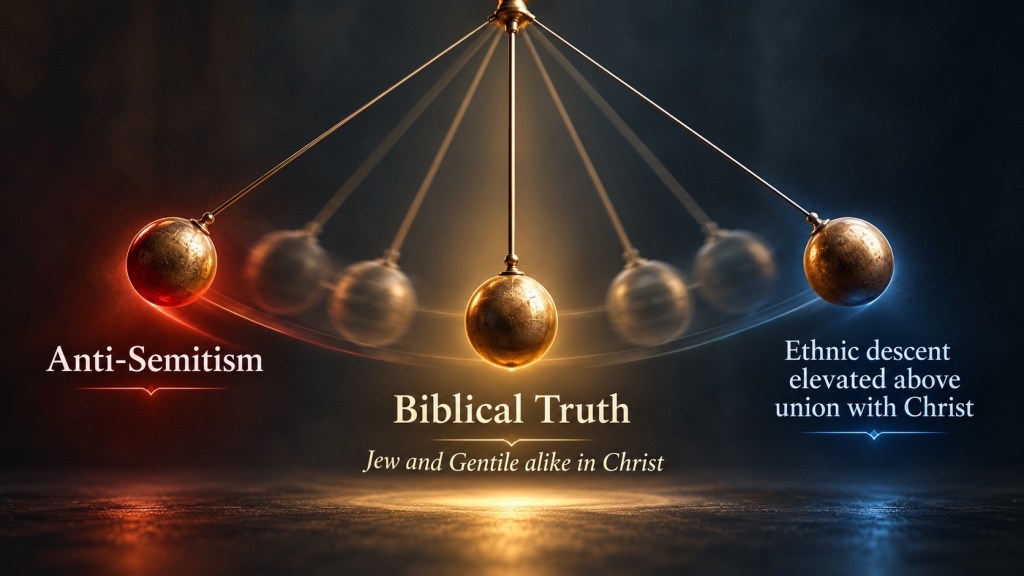
Unfortunately, some expressions of dispensational theology have moved toward the opposite extreme of elevating ethnic descent above union with Christ by placing renewed emphasis on ethnic Israel as a separate covenant people apart from the New Covenant realities fulfilled in Christ. Some have even suggested that Jewish people may have a separate path to salvation apart from faith in Jesus.
For example, dispensationalist John Hagee stated:
“I believe that every Jewish person who lives in the light of the Torah, which is the word of God, has a relationship with God and will come to redemption… Jews already have a covenant with God and that has never been replaced by Christianity.”
This view misunderstands the purpose of the Mosaic Covenant and its fulfillment in Christ. As we have already seen, the Old Covenant was temporary by divine design, has reached its fulfillment in Christ, and is now described by Scripture as “obsolete” (Hebrews 8:13). It therefore does not provide a continuing path to God alongside the New Covenant established through Jesus. The New Testament consistently teaches that salvation is found only through Christ, whether someone is Jewish or Gentile.
The biblical answer, then, is neither to elevate nor diminish any ethnic group, but to maintain the proper balance: God’s purpose in Israel was always to bring blessing to the nations through the promised Seed, Jesus Christ. All who belong to Him are now His chosen people, His royal priesthood, and His holy nation.
This priestly identity also carries a mission: every Christian is now an empowered priest whose calling reflects Israel’s original role. We are not passive recipients of God’s blessings; we are called to proclaim the One who has blessed us. As priests in the Kingdom of Jesus Christ, we point others to the perfect sacrifice that restores sinners to God.
His name is Jesus, and He is the true Israel of God.
Because we belong to Him, we should pray for and participate in the advancement of His Kingdom (a theme we’ll continue to evaluate in our next study):
“Your kingdom come. Your will be done on earth as it is in heaven,” (Matthew 6:10).
Those redeemed by Jesus are now God’s chosen people, not because of physical descent, but because they belong to Christ. As His royal priesthood, we are called to carry His name to the nations and proclaim the Good News that through the true Seed of Abraham, all nations may be blessed.

